


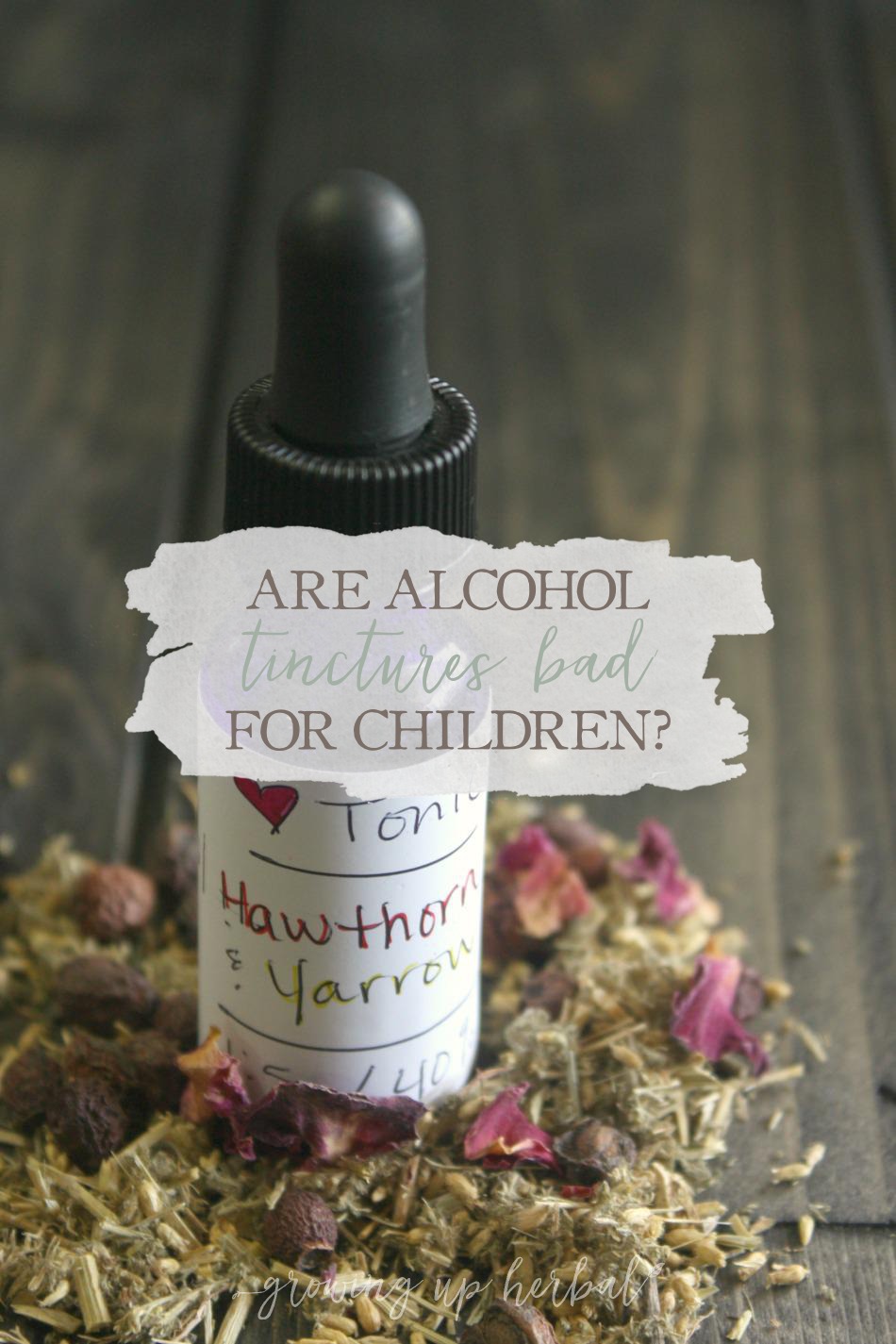
Many parents want to use herbs to better their child’s health, but questions about safety come to mind, especially when giving their child an herbal tincture extracted in alcohol.
Most parents new to herbs wonder whether alcohol tinctures are bad for children. I mean, alcohol is bad for anyone if too much is used too often, right? And, because children are much smaller in weight and their bodies don’t metabolize toxins the way an adult’s body does, wouldn’t it make sense that there should be some worry around giving alcohol to them… even if it’s in the form of a natural, herbal medicine?
So here’s the big question.
“Are alcohol tinctures bad for children?”
Will the amount of alcohol a child would receive in several doses of an alcohol-based herbal tincture several times a day harm them? Are these forms of herbal medicine okay for children to take when needed?
Now, I’m not here to convince you one way or the other. This decision is up to you as your child’s parent, but I want to share some basic information I’ve found to help you make a better decision… or at least an easier one. We all want to sleep well at night knowing that we’ve done what’s best for our child, right?
Below, you’ll find some reasons why alcohol is a great solvent for herbs, as well as a few innocent, everyday places one might consume alcohol without even realizing it. I’ll also be showing you just how much alcohol your kiddo is actually ingesting from that tincture they’re taking, and we’ll look at how much alcohol is required to impact their body negatively. We’ll hear what Dr. Aviva Romm, an experienced herbalist, midwife, and medical doctor, thinks about giving alcohol tinctures to children. Lastly, I’ll share some alternatives to alcohol tinctures you can use with your children if you skip alcohol extracts entirely.
3 Reasons Alcohol Is A Great Solvent For Herbs
1. Alcohol Extracts More Compounds From Herbs
Herbs and foods contain fat soluble and water soluble compounds, and alcohol is unique in that it can extract both of these compounds from the herb, giving you a well-rounded end product.
2. Alcohol Is Fast-Acting
Alcohol is also one of the fastest ways to deliver herbal nutrition into the body. Tinctures made from alcohol are absorbed directly into the bloodstream via the mucous membranes of the mouth, throat, and stomach lining. Even placing it under the tongue will get it quickly into the bloodstream, bypassing digestion altogether.
3. Alcohol Extends The Shelf-Life
Alcohol also gives tinctures a longer shelf-life than other preservation methods, and it helps preserve the potency of the active constituents for a longer time. I love making herbal tea, and we drink it frequently even though it only lasts a few days. Compare that to an alcohol-based tincture that will last two years or more!
Everyday Foods That Contain Alcohol
Did you know that small amounts of alcohol can be consumed via eating everyday foods?
It sure can!
Fermented foods, ripe fruits, and some drinks are just a few examples of foods that contain small amounts of alcohol. Let’s look at these a bit closer.
Fermented Foods
Home-brewed kombucha is a healthy and delicious way to increase digestion and get some healthy fermented foods into the diet. Kombucha contains about .5-1% of naturally occurring alcohol from the fermentation process, and I’ve heard different varieties of kombucha (such as Jun kombucha) can have even more. Even store-bought kombucha has small amounts of alcohol in it.
Sure, kombucha contains a small amount of alcohol from the natural fermentation process, but so do other fermented foods like traditional sauerkraut, fermented fruits, and fermented veggies. Fermented foods are very healthy for the body as they increase the food’s nutritional value and its probiotic and enzyme content too!
Ripe Fruits
Ripe bananas off-gas a large amount of ethanol due to their natural alcohol content — about .5g per 100g of banana (Gorgus et al., 2016). This is why it’s recommended to store bananas separately from other fruits, or they’ll cause them to ripen too quickly and spoil. The amount of alcohol per dose of tincture is less than what’s found in a ripe banana. I don’t know about you, but my little guy can down a lot of bananas!
Common Beverages
Even beverages like orange juice have been found to have levels of alcohol worth mentioning. And you may not drink soda, but back in 2012, popular cola brands like Coca-Cola and Pepsi were found to have trace amounts of alcohol in them as well.
As you can see, alcohol is a natural part of the fermentation and ripening processes in many foods. With this being said, you can see how easy it is to consume small amounts of alcohol daily.
How Much Alcohol Is A Child Ingesting From A Tincture?
The amount of alcohol a child consumes from a tincture is very small.
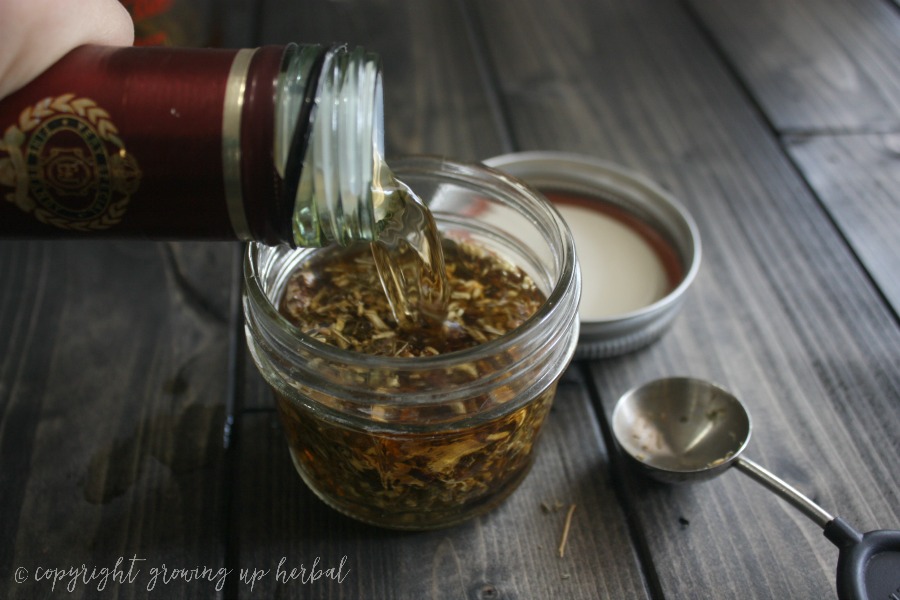
For example, when it comes to tinctures made via the folk method, 100-proof alcohol is what is often used. This means that your alcohol will contain 50% water and 50% alcohol.
One dosing method that people often follow for folk tinctures suggests 1 drop of a 50% tincture per 2 pounds of body weight.
Since the average 5-year-old weighs 40 pounds, they’ll get 20 drops of tincture. Remember that this is at least half water, so let’s say that’s 10 drops total of alcohol. If these 10 drops are diluted in half of a cup of juice, this would end up being .5% worth of alcohol. Now .5% really isn’t that much, especially considering that it’s about the same as you’d find in kombucha or a ripe banana.
How Much Alcohol Will Negatively Affect My Child?
Most of the information out there on alcohol and children is about how bad it is for them, and rightly so. However, much of the information refers to whole drinks of alcohol, not drops of an herbal tincture made with alcohol.
To get some perspective, though, the United Kingdom health service recommends that adolescents (15-17 years old) not exceed 50 milliliters of hard liquor daily. That 50 milliliters are roughly 1,000 drops (10 teaspoons), give or take a few.
But what about young children? How does this information apply to your little ones?
Several dosing equations can help us out.
The first is called Fried’s Rule of dosing, which takes the child’s age in months, divided by 150, then multiplied by the adult dose. Clark’s Rule is similar and requires the child’s weight in pounds, divided by 150, then multiplied by the adult dose.
So, for example, let’s say we have an average-sized, 70-pound 10-year-old child. This child’s upper limit of daily alcohol will probably be around 600 drops a day based on the 15-17-year-old suggestion above. Using Clark’s Rule dosing formula and the average adult’s 30-drop tincture dosage, the child’s dosage would end up at 14 drops of tincture for each dose, which puts them just under 3% of what would be estimated as the absolute max for their body a day.
And just for the record, if you run this example through both dosing formulas, you’ll notice that you get very different dosages. This is why many herbalists prefer weight-based dosages over age-based, especially for herbs that need to be exact. No matter, both formulas are great!
What Do Experienced Herbalists Say About Giving Children Alcohol Tinctures?
Now, I know a lot of herbalists who use alcohol tinctures with children without hesitation. Still, I remember being new to herbs and worrying about giving my little one tinctures made with alcohol. So, I decided it would be nice to hear what someone in the medical industry said on this topic.
Dr. Aviva Romm is well-known in the natural health community as well as the modern medical community. She is an herbalist and midwife who’s raised four children using herbs and is a Yale-trained medical doctor too. She has a lot of experience working with children, and I was curious to hear her thoughts on this topic. Here’s what she had to say.
“Used appropriately, liquid herbal extracts—tinctures—are among the most valuable and effective botanical tools for treating children’s health concerns. They are very concentrated so only small doses are required, and they can easily be hidden in water or a tiny amount of juice with practically no taste for most herbs that you’d use with kids. The amount of alcohol in a dose of tincture is extremely small; however if you are concerned, many herbs are available in glycerites. IF you do use alcohol tinctures with your kids, dilute the tincture in 2 tablespoons of water—alcohol shouldn’t be put directly in the mouth due to risks of damage over time to the delicate oral mucosa. Warmly, Aviva”
3 Ways To Decrease The Amount Of Alcohol In Tinctures
You’re probably okay about giving your child alcohol-based tinctures at this point, but if you’re still hesitant, no problem. No one is forcing you to be okay with it, and the good news is that you don’t have to skip using liquid herbal extracts just because you want to stay away from alcohol. There are some other great options for getting these herbal preparations into your children, minus the alcohol.
1. Evaporate It Out
First, you can try to evaporate some (around 15%) of the alcohol out of the tincture by putting the recommended tincture dose into a hot cup of tea and giving it to your child after the tea has cooled. The hot tea will cause some of the alcohol to evaporate out with steam (USDA, 2007).
2. Change The Route
Next, you can skip the internal route altogether and use the tincture externally. Alcohol-based tinctures can be rubbed onto the skin or the bottoms of the feet instead of being taken internally. Just remember, you would need to increase the amount you use when applying it topically instead of internally.
3. Change The Type of Preparations
Lastly, herbal tinctures can be prepared in other forms using honey, glycerin, or vinegar. These work a bit differently in the body and don’t extract the nutrients in the same way alcohol does. Nonetheless, it’s still a good option.
- Herbal honeys – herbs steeped in honey.
- Herbal glycerites – made with a blend of glycerin and water.
- Herbal vinegars – extracted with vinegar, good for extracting minerals.
You can read more about tinctures, herbal vinegars, and glycerites here.
All Things Considered
- Alcohol-based tinctures are an effective and time-tested way to deliver herbal remedies to children of all ages.
- The dosage of a tincture is the same or less than the alcohol found in common foods and a small fraction of what’s considered to be the harmful maximum.
- Many well-known herbalists and doctors do not have a problem giving their young patients alcohol-based tinctures.
- Other great herbal preparations can be used if you choose to forgo alcohol in your herbal medicine cabinet.
So what do you think? Are alcohol tinctures bad for children? Whatever you choose, the decision is up to you to do what you feel is best for your family. The right choice will depend on different factors, and whatever you decide is the right choice for your kids is okay.
What are your thoughts on this topic? Share your comments in the comment section below!
REFERENCES:
- Gorgus, E., Hittinger, M., & Schrenk, D. (2016). Estimates of ethanol exposure in children from food not labeled as alcohol-containing. Journal of Analytical Toxicology, 40(7), 537–542. https://doi.org/10.1093/jat/bkw046
- USDA Table of Nutrient Retention Factors. (2007). Retrieved from http://www.ars.usda.gov/SP2UserFiles/Place/80400525/Data/retn/retn06.pdf
Thank you so much for this! I have been hesitant for years about alcohol based but know that the alcohol extracts the herbs better. Thank you for providing factual information so I can be educated in my decision!
You’re very welcome, Kay!
Thank you for this great information. My instincts were telling me that giving my kids alcohol tinctures was all right because of the small amount of alcohol they consume once diluted in water, but it was affirming to have the scientific explanation as to why it is safe.
I’m glad this was helpful, Jessica!
Great info! I agree!
Thanks, Jill!
This is such a great post! I really could have used this information when I used to work at a natural health food store. SO many people ask this very question! Thanks for sharing 🙂
[…] Click here to read the rest of my article at Growing Up Herbal. […]
[…] A tincture is the easiest was to take advantage of the soothing properties of chamomile for teething. I purchased a bottle of the Herb Pharm tincture and was pretty much sold on chamomile within the hour. To administer, I added her dose of tincture to a cup mixed with an ounce or two of water. My daughter is not a big fan of liquids that don’t come straight from mom, so I keep the tincture very concentrated to get her to drink as much as possible. Here’s an informative piece if you are concerned about the use of alcohol in a tincture for children. […]
I assume that this applies to homeopathic remedies as well? I had never heard of mucosal damage occurring when using in diluted. In fact, we have always been instructed to administer them under the tongue without dilution…
I’m not entirely sure what you’re asking. From my understanding of homeopathic remedies, they’re already diluted so you can administer them directly in the mouth, under the tongue. As for alcohol tinctures, it’s recommended to dilute them as the alcohol can negatively affect the mucous membranes, however, depending one the tincture and the issue you’re taking the tincture for, sometimes, it’s advised to take it directly in the mouth without diluting it. An echinacea tincture in 40% alcohol is a good example of this if you’re taking it for an infection as you want the tincture to come into direct contact with the bacteria. Does that make sense, and does it answer your question?
Hi Jamie! I don’t know where to ask this question and I’m really happy that I found your blog. I have a one year old daughter and I want to give her a kind of herbal tonic (consist of many herbs) which is alcohol based. I think it would be considered as a wine since it has a naturally occurring alcohol of 9%. My parents swear by it but I have been hesitant to give it to her because of the alcohol. I was wondering if I could also use the dosing equations for me to be able to administer it to my baby? Should it also be diluted even if it’s only 9% alcohol? Thank you!
Hi Anj. I think it would be hard to say how much to give your little one without knowing the ingredients and amounts in the recipe. 9% alcohol doesn’t sound like much, but I’d immagine that it would still be a good idea to dilute it. Sorry I’m not much help here.
Hi Meagan! I don’t know where I got the name Jamie. Haha. Sorry. Anyway, thank you for response. The wine consists of 18 herbs though. If 9-12% isn’t that much for you, then it’s probably ok to give it to my daughter. Thank you for your response. Really appreciate it!
It’s no problem, Anj. A fellow blogger friend of mine (and past GUH contributor) whose name is Jamie actually wrote the article. And, if I were you, I’d try it yourself before giving it to your little one to make sure it’s not too strong. If it tastes too strong, it can be mixed with juice or some honey and taken that way. Hope that helps!
Hey! What about babies? I’ve read about chamomile tincture being used to help babies with teething.
Yes, you can definitely use alcohol tinctures with babies if you’re comfortable with it. Babies would get an even smaller dose of tincture than even a small child so they would consume very little alcohol. However, if you’re not comfortable with it, a glycerite is another great option. I talk about using chamomile tinctures for teething in this post here.
Hey Meagan, I was wondering how this would apply to elderberry. I read one recommendation of giving children a tablespoon of elderberry extract that had been made with 40 proof vodka. Not sure how many drops are in a tablespoon. That just seemed like a lot for my 5 yr old. The idea of evaporating it into a tea sounds good to me. This will be my first experience making a tincture. Thank you!
Hi, Emily. A tablespoon of an elderberry extract seems like a large dose for a child, but it will really depend on the other ingredients in the extract. Most tinctures are dosed at 30-60 drops for adults (which is between 1/2 and 1 teaspoon of liquid). A child’s dose would be much less. If I were making an elderberry tincture using dried elderberries, I’d follow the folk method here. Hope this helps!
Maybe this is the dosage for elderberry syrup, which has no alcohol but is preserved by honey.
Perhaps, but she did mention that the elderberry extract was made with a 40% vodka, so I was giving her information on dosing for an alcohol-infused preparation.
5
In this article, you say:
1. Evaporate It Out
First, you can try to evaporate some of the alcohol out of the tincture by putting the recommended tincture dose into a hot cup of tea and give it to your child after the tea has cooled. The hot tea will cause most of the alcohol to evaporate out with the steam.
But in another article, (https://growingupherbal.com/using-herbs-herbal-tinctures-glycerites-and-vinegars/) you say:
“What About Evaporating The Alcohol Out Of A Tincture With Hot Water?
Many people will say to boil water, pour it in a cup, and drop their tincture drops in there to evaporate the alcohol off, but did you know that this is a misconception? Yeah, it is! Only a small amount of the alcohol will evaporate this way (around 15%). Alcohol disperses in water, and it’s very difficult to separate them. Plus, when you add tinctures to hot waters you can lose some of the essential oils and other constitutes in the tincture. (USDA, 2007)”
Uhhhhh so which is it?
Thanks for pointing this out, Daniel. I’ve updated this post to reflect the USDA article that states that around 15% of alcohol is evaporated out since that’s the only source I have for this info. If I ever come across newer findings for this, I’ll do my best to update both blog posts again.
Gosh! When I was a little kid -I mean 3….5….7 years old, we were given a teaspoon of Brandy if we’d been sick. Did me no harm that I’m aware of! We were also allowed a very tiny glass of home brewed wine -usually Quince or Blackberry -with the weekend meals. I am now 65 and have no health problems. (Mind you -I’m nuts!! haha)
I can’t tell people what to give their children of course but small amounts of alcohol did us no harm. Anyway it is possible to make Glycerin tinctures if that idea is too unpalatable. The thing is with Glycerin tinctures, they don’t store as well or keep as long as the alcohol ones.
Bear in mind also that for a child’s body weight they will probably be having half the adult dose, and that doesn’t work out at very much alcohol per day. (One to one and a half teaspoons?)
Well said, Sylvia. Thanks for sharing, and I agree with you about the glycerine tinctures. They’re very useful, especially for children.
This was a super helpful, data driven article that really helped me make my decision feel rationalized! Thank you for putting this together for us worried, hippy moms!
You’re very welcome, Kim. Thanks for the comment, and I’d love it if you’d share the article with your natural mama friends! Thanks!
I’ve been reading your blog all day because you provide detailed explanations, and honestly, it’s making me feel more at peace with my decision to start using herbs on my one and only (for now) baby! I do have a question though, where can I find the limit amount of alcohol for children under 15 years? My baby is 2 months old and I do not know how much alcohol is too much. Google tells me any amount of alcohol is bad lol
Hey, Thesa. I don’t think you’ll find alcohol limit recommendations anywhere for children, just as there’s not an alcohol limit for adults (other than while driving, that is). You can research alcohol metabolism by the liver for adults, though. That will help you learn how long it takes for a certain amount of alcohol to be completely metabolized by a healthy adult liver. Just know that for children, it will take longer. Also, when using tinctures in children, you’ll need to take the recommended adult dosage (usually found on the tincture bottle or in the recipe) and convert it to a child’s dosage. You can learn to do that here. In any case, even for adults, the amount of alcohol one consumes from a tincture is very small and not a burden to a healthy body.
Now, let me caution you against using tinctures, or any herbs for that matter, with a two-month-old baby. A two-month-old should have no need for herbs at this point in their life. Most infants don’t need herbs for wellness purposes as mama’s milk and antibodies passed to them while in the womb is enough to keep them well until they’re 4-6 months old. If they do get sick before 3-4 months of age, it’s best to take them to their pediatrician. Once they’re 4-6 months old, you could consider using gentle herbs when needed. If you’re breastfeeding, it’s better for you to take the herbs and baby will get a small amount of them through the breastmilk. If you’re not nursing, you can make teas, figure out their dosage, and give it to them that way (testing for allergies first!!).
Hope this helps, and let me know if you have any other questions!
4.5
1
Hi! I skimmed through this article looking for an answer to this question: If I make elderberry syrup and the yeaild is 2 quarts of syrup, and then I add 1 + 1/4 cup of vodka to stabilize the syrup for longer storage, is it still safe to give my kids (under the age of 10) 1/2 tsp/day?
Yes, there would be very little alcohol consumed in 1/2 tsp. a day.
Thank you. This was reassuring.
You are very welcome!
I’m concerned for myself, an adult, because alcohol held in the mouth mucosa enters the blood stream directly and impacts the brain more than if it went through the digestive system. I feel the effect of alcohol swished in my mouth twice as fast, or more, than if I swallow it.
If the tincture is strong enough to make my mouth tingle as if I had held 40 proof liquor (which I have never appreciated) then I know it’s having a substantial effect on my brain, and the effect, as lots of research shows, is unhealthy.
So, I forfeit the increased potency of herbs in favor of protecting my brain.
I hear what you’re saying, Peter, but a child’s dose of a tincture would be drops of the tincture (usually made with an alcohol containing 50% abv – so essentially half alcohol and half water) further diluted in water or juice that is then swallowed and not held in the mouth. Over-the-counter children’s medicines, like cough syrups and whatnot, have more alcohol than that! While I’m personally not concerned that several drops of a tincture will negatively affect my child, parents who are concerned can always go with herbal glycerites as they work almost quite as well as tinctures.
You said that the dose for a 5 year old child would be around 10 drops, which when diluted in 4 oz of orange juice works out to be .5 percent alcohol—comparing this to the alcohol content in a ripe banana. But a ripe banana has point ZERO FIVE (.05) percent alcohol, which is different by a factor of TEN. So I get the point you are making, but this is pretty misleading if you don’t actually do the math.
Hi there. Thanks for your comment. Ripe bananas actually vary based on how ripe they are, often ranging from .4g/100g and up. You are referencing their alcohol content based on liters, which would be .04-.05g/L. I’ve updated the article to clarify that I’m referencing their alcohol content per 100g of banana, and I’ve also included a link to a 2016 study on this exact topic. Hope that helps to clarify further.