


Spring is officially in full swing here in the Northern Hemisphere, although I’ve been in spring mode for well weeks now.
As the days continue to lengthen and warm, I’m feeling the urge to spend more time outside in nature. Do you feel it too?
One of my goals as an herbalist this year is to forage or grow more of the herbs I use in my home apothecary rather than purchasing them from local shops or online.
Now don’t get me wrong. I’m not against those things. In fact, I’m all for supporting local businesses, and I will continue to do so when needed.
However, I think it’s an essential skill to identify the plants in your area, learn how to harvest them correctly and at the right time, and then preserve them for future use.
Since I’m starting from scratch when it comes to growing herbs at our new home, I’m going to have to rely on foraging many of the herbs I want to use here at home, at least until my herb gardens are established.
With that said, I’m sharing 15 herbs with you below that I plan to keep an eye out for this spring. These herbs all grow in the North (and many in the South), but they’ll vary depending on climate and growing zones.
Okay, so let’s take a look at some herbs to keep an eye out for in early spring.
15 Herbs to Forage in Spring
Before I share the following herbs, I want you to know that this is not an exhaustive list. There are MANY more herbs popping up here in the Northern Hemisphere during spring. The herbs I’ve included below are easy to identify, and most of them grow close to home. While some herbs will not flower until late spring or summer, the leaves will grow in spring.
For each herb, I’ll briefly explain how it’s used, where you can generally find it growing, and some basic characteristics that will help you identify it.
Much of this information is off the top of my head. Still, some are referenced from The Herbal Academy’s Herbarium, EdibleWildFood.com, my herbalist friend, Colleen Codokas’ website, Grow Forage Cook Ferment, as well as The Foraged Foodie’s blog.
I would highly recommend checking out each of these sites if you’re interested in learning more about foraging plants and eating wild foods!
I’ve also included links to some new sites I found while researching these spring herbs throughout this article and in the reference section below if you want to look into those.
Dandelion
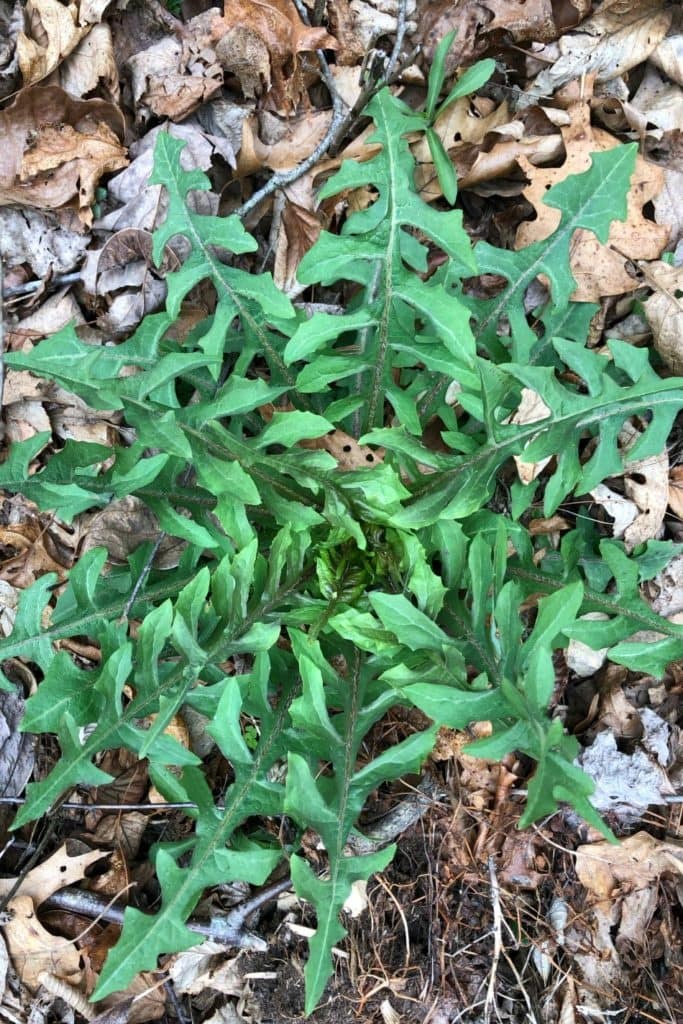
Here in East Tennessee, dandelion (Taraxacum officinale) can be found throughout winter, mainly if the winter is a mild one. The leaves lay low to the ground, and come early spring, a flower bud emerges and unfurls by mid-March, if not sooner.
Young dandelion flowers and leaves are often used in food as they are high in vitamins and minerals. As the leaf ages, it becomes more bitter, stimulating digestion and supporting liver health. The root of dandelion can be harvested in the spring and used as a liver tonic as well. Dandelion leaf is a diuretic that increases urine output without causing you to lose too much potassium.
You can find dandelion growing EVERYWHERE — in good soil, in poor soil, in sunny and shady locations, in high and low elevations — just everywhere!
Dandelion leaves are deeply toothed, hairless, and grow in a basal rosette pattern. The leaves vary in size depending on the plant’s age and can range from 2-16 inches in length. The stalks are hollow and have a sticky, milky-looking latex that flows from them when broken. Each stalk produces one single flower, or rather, a ray of individual flowers called florets. Multiple stalks grow from one plant. Each plant grows from a pale-colored taproot that penetrates deeply into the soil, making dandelion challenging to remove.
Dandelion is a cooling, drying plant that is useful for digestive, hepatic, and urinary conditions. It’s frequently used as an herbal bitter to stimulate digestion before meals. It’s also an alterative herb that’s used to gently tone and strengthen the liver. The leaves are diuretic which can help increase urine output and further remove toxins from the body.
Chickweed

You can find chickweed (Stellaria media) growing through winter in some locations, but it flourishes during the warmer, wetter weather of spring.
Chickweed has many wellness benefits. It is a cooling and moistening plant. In the spring, it is mostly used in foods for its nutritive properties. It is considered an alterative herb due to its actions on the lymphatic system. It also acts as a diuretic as well, helping to stimulate that channel of elimination. It can be soothing to the digestive tract thanks to its cooling, demulcent properties. It is also very beneficial for hot skin conditions, like bug bites and rashes, thanks to its emollient properties. When I think of chickweed, I think nutrition, gentle cleansing, and soothing!
Chickweed loves the shade, but you can sometimes find it in partial shade. It grows low to the ground and spreads like crazy! It is found all over the Northern Hemisphere in locations that are moist and not too sunny!
Several species of chickweed vary slightly, but most have these common identifiable characteristics. Chickweed has one thin taproot with many smaller rootlets branching from it. Its roots grow close to the surface and are easy to pull up. Fine hairs cover the flower sepals, buds, leaves, and stem of chickweed, and on the stem, these hairs run up one side, switching to the other side at each leaf pair! Leaves grow in opposite pairs up the stem. They vary in shape from the bottom to the top, but they are smooth-edged and small. Each white flower, which opens in the morning and closes in the evening, consists of 5 petals—each petal has a deep cleft in it, making it look like two petals instead of one.
Violet
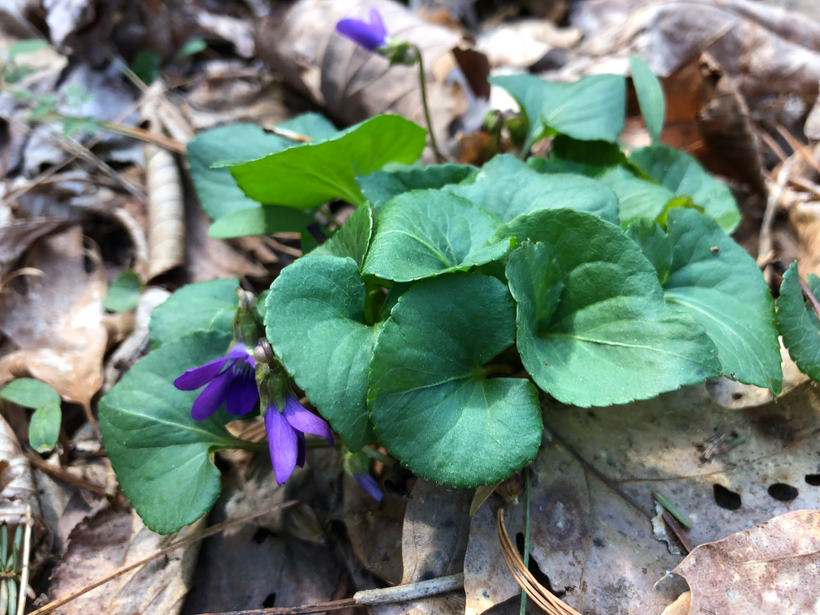
Violet (Viola spp.) is a beautiful spring flower, scattering its pretty purple, yellow, or white flowers (and sometimes multi-colored flowers) all across the ground.
Violet, like many spring herbs, is quite nutritious. The leaves and flowers are used in many different foods and drinks. It also has diuretic and lymphatic actions, stimulating urine production and lymph movement. With its cooling, relaxing properties, it is one of my favorite nerve tonics. It’s also a great herb to soothe inflammation internally and externally.
Violets like moist shady areas. However, they can sometimes be found in sunny areas if there’s enough moisture. If growing in sunnier locations, you’re more likely to see the leaves instead of the flowers, though. Violet grows in temperate climates, in moist, well-drained soil.
Violet characteristics vary depending on the species you are looking at, but most violets have heart-shaped leaves that alternate up the stem. The leaves have a toothed edge and are mostly hairless. Violet flowers consist of 5 petals, each with an inner white area that often looks a bit fuzzy or hairy.
Purple Dead Nettle
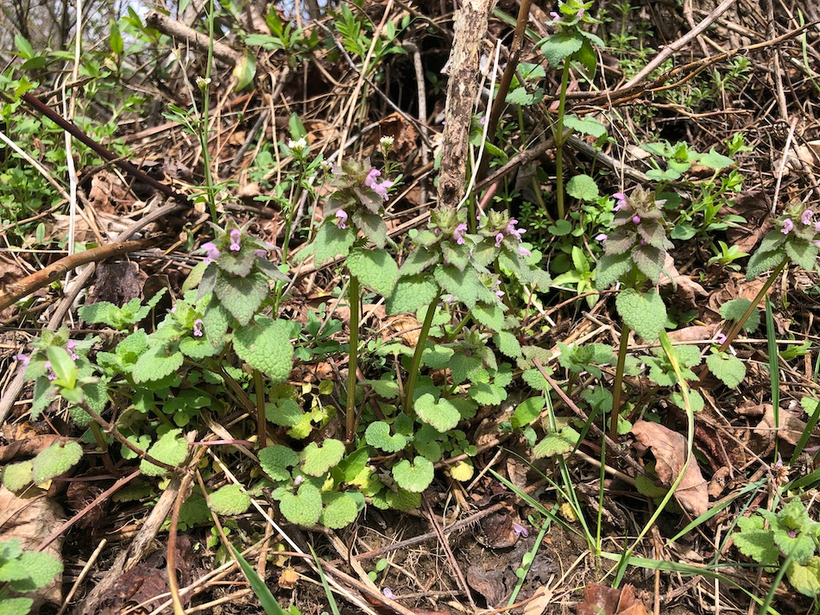
Purple dead nettle (Lamium purpureum) is another of spring’s early bloomers. It likes to grow with other spring greens, and once you learn to recognize it, you will see it everywhere!
Purple dead nettle is a nutritious plant, and the leaves are often used in food. It’s a bit hairy, so it’s best to use it sparingly in raw foods. However, cooking it or blending it into soups or smoothies can help with the texture. Younger plants will also be more tender than larger ones.
According to herbalist Colleen Codekus, purple dead nettle has diuretic and antibacterial actions. If you suffer from occasional urinary tract infections, I would imagine this herb would be an excellent infusion to try. However, Colleen also mentions that it can be a laxative for some, so it may be a good idea to use this in small amounts in an herbal formula!
Purple dead nettle is an excellent herb for spring allergies due to its ability to ease inflammation. The leaves have astringent and styptic properties making this plant a great choice to slow the bleeding of external wounds and reduce heavy menstrual bleeding!
Purple dead nettle grows in open disturbed areas. As a member of the mint family, it can easily take over a plot of land. In fact, its scientific name, Lamium purpureum, means “devouring monster!” While it does well in moist, well-drained soils, it also thrives in sunny areas as well.
Purple dead nettle has a square stem with triangle-shaped leaves attached and bunched around the stem. Leaves are green in color and gradually turn red or purple toward the top of the plant. Flowers are a pink-purple color, tubular, and have both an upper and lower lip that curl. Fine hair covers the whole plant.
One word of caution here. The early growth of purple dead nettle can easily be confused with the early development of foxglove, a poisonous and deadly plant. It’s best to wait to harvest purple dead nettle when the upper leaves and flowers grow on the plant and you have positively identified it.
Henbit

Henbit (Lamium amplexicaule) grows abundantly in the spring and is a cousin to purple dead nettle. Because these plants are so similar, they may share many of the same energetics and therapeutic uses.
Henbit is well-known for its vitamin, mineral, and fiber content that is often foraged by livestock. Henbit looks quite a bit like purple dead nettle, and the two plants are often confused with each other.
Henbit, like purple dead nettle, is from the mint family. Thus, it has that distinguishing square stem. It grows from a taproot, can grow 6-18 inches tall, and spreads easily. It flowers with tiny flowers ranging in pink, purple, and red shades. The flowers have spots on the lower lip and tiny purple hairs on the upper part. They also have no scent.
One of the distinguishing factors between henbit and purple dead nettle is that henbit has hairy heart-shaped leaves with big scalloped edges that grow along the stem’s entire length. The leaves also bend downward toward the stem as if they’re trying to grab onto it. Henbit’s leaves have a purple coloring at the bottom of the plant, turning more green toward the top. On the other hand, purple dead nettle has triangular-shaped eaves that are greener towards the bottom leaves and purple toward the top.
Ground Ivy
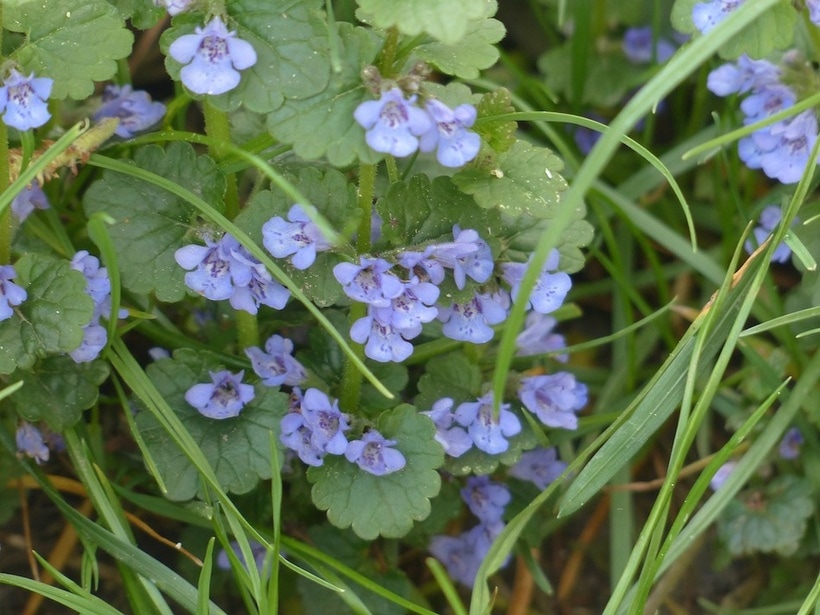
Ground ivy (Glechoma hederacea) is a creeping, perennial herb belonging to the mint family (Lamiaceae). It prolifically spreads as it sends out runners or stems that can grow as long as 7 feet! These runners root at the nodes and form patches or clusters of ground ivy. It has characteristic square stems with round or kidney-shaped leaves that grow opposite one another. It produces small blue-violet, funnel-shaped flowers. The flowers have a strong scent when stepped on or rubbed due to volatile oil content, which helps distinguish ground ivy from other similar-looking plants, such as henbit, garlic mustard, or common mallow.
Ground ivy is energetically cooling and has an affinity for the respiratory, urinary, and digestive systems. Historical uses include wound repair internally and externally, easing inflammation in various parts of the body, soothing digestive cramping, bringing on menses, increasing urine output, and stimulating the liver.
Ground ivy has a bitter, pungent, and aromatic taste. This taste says a lot about ground ivy’s historical uses as each of these flavors is stimulating to the body, getting fluids and energies moving, and slowly bringing tissues back into balance.
Yarrow
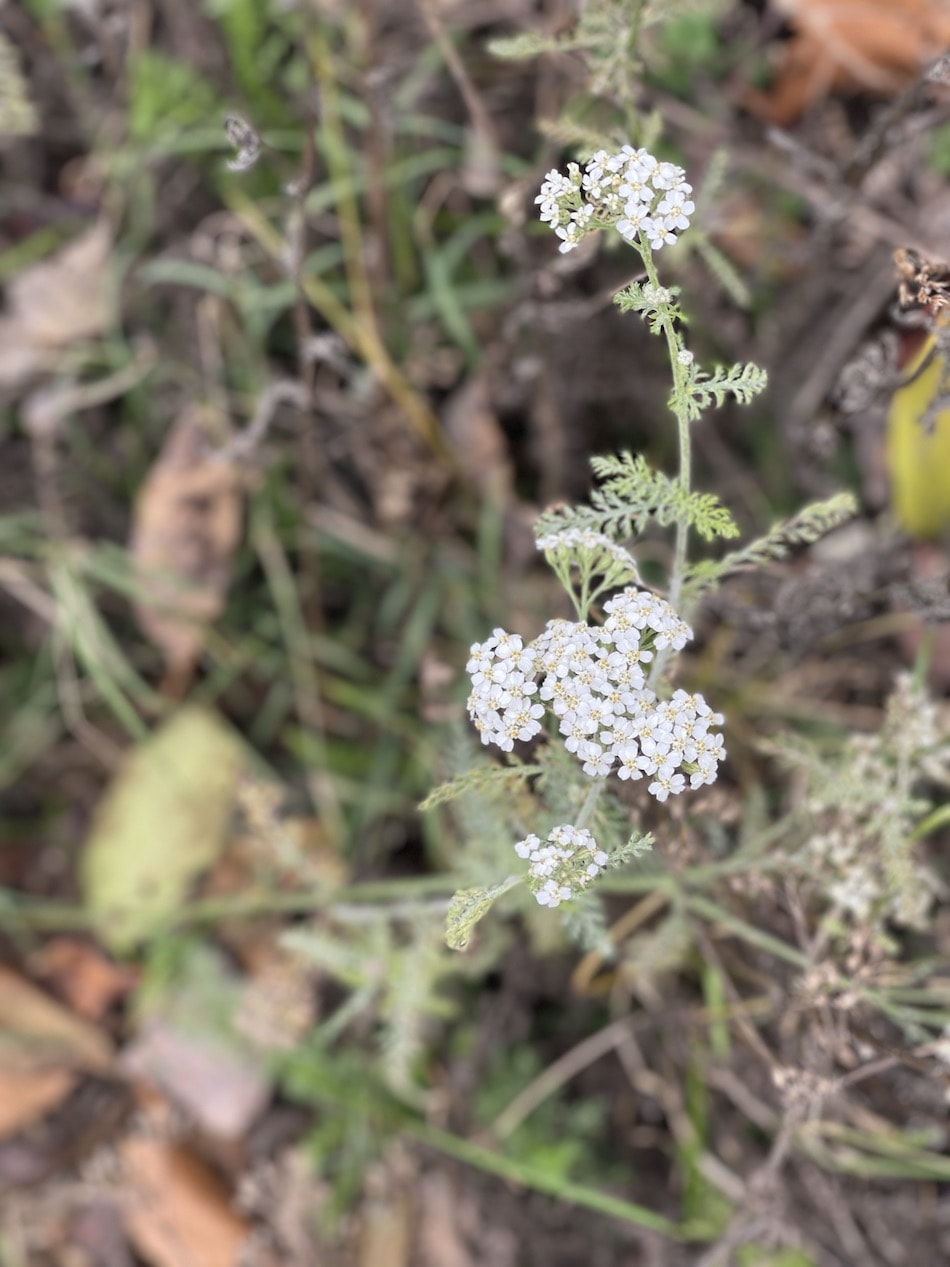
Yarrow (Achillea millefolium), while some might not consider it an authentic spring herb, begins to show more of its deep green feathery leaves in the early spring months here in Southern Appalachia, which is why I include it in this list.
Yarrow helps to slow the bleeding of external wounds due to its astringent action. This action also works as a tonic to tighten and tone the entire cardiovascular system! Yarrow also has antimicrobial and antispasmodic properties due to its high volatile oil content making it great to use for bacterial infections, colds and flu, and gastrointestinal cramping. It also causes the skin’s pores to open when drunk as a hot infusion, which helps cool the body when it is overheated. Lastly, yarrow has bitter constituents and can be used in tincture form before meals as an herbal bitter to stimulate digestion.
As you can hopefully see, yarrow has cooling, drying, toning energetics. These energetics make it a great fit for conditions that present with opposite energetics.
Yarrow grows in sunny areas where the soil is quite sandy. However, it also grows in moist, well-drained soils too.
Yarrow can grow up to 3 feet tall. Its leaves are a deep green color, and they have a delicate, lacy, fern-like appearance. In early spring, the leaves grow directly from the ground in a thick mat or clump due to yarrow’s rhizome root system, the stem eventually rising as the season progresses. Clusters of creamy white flowers emerge at the end of the stems.
Bitter Dock
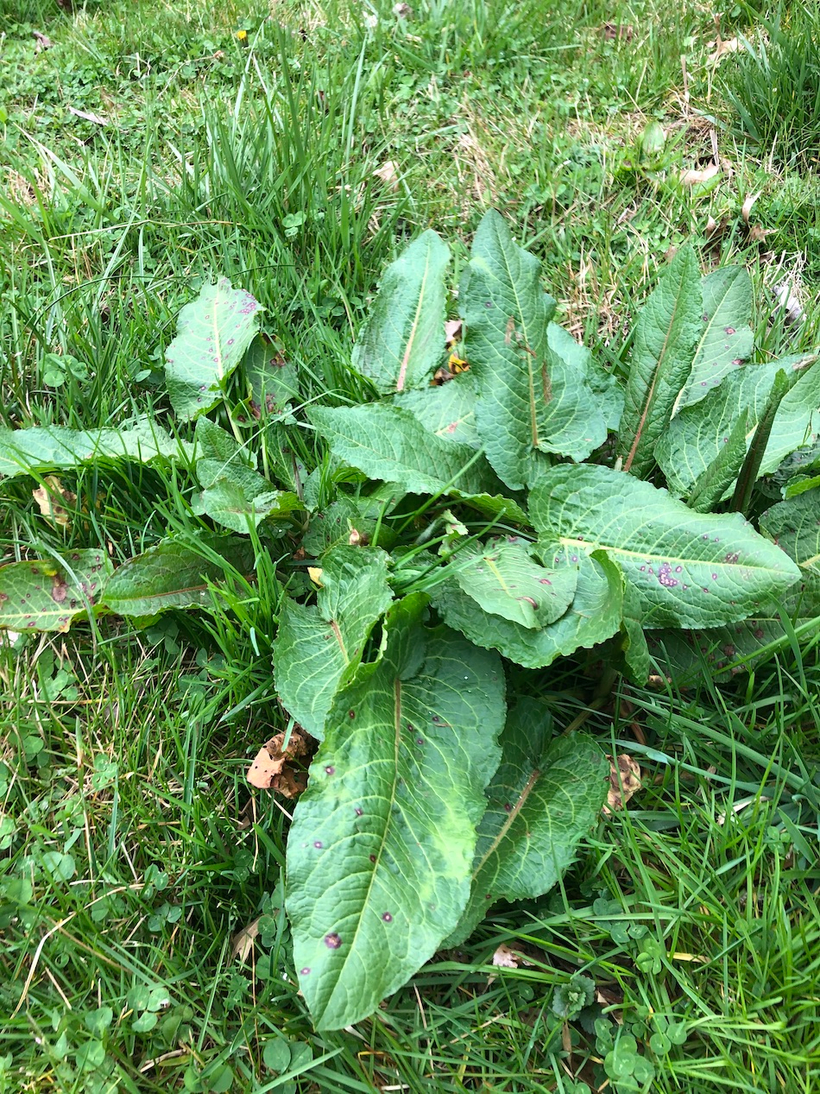
Bitter dock (Rumex obtusifolius), aka; broadleaf dock, is a cousin to yellow dock (Rumex crispus), aka; curly dock, another spring herb, but since this one grows in abundance around my home, I thought I’d share a bit about it today.
Bitter dock leaf and stem are, as you might have guessed, quite bitter. However, they’re also quite nutritious as they contain a fair amount of minerals useful to the body. If you pick them young, you can add them to certain foods to lessen their bitter flavor. Otherwise, you may want to tincture them to use in your bitter herbal preparations. You can use bitter dock leaves to soothe burns, scalds, and blisters when used as a poultice. The root of bitter dock is exceptionally astringent and has been used to slow bleeding internally and externally and support liver function.
You can find bitter dock growing everywhere. While it prefers moist, shady locations, it is found in hotter climates as well. It’s not too picky about soil conditions either, as long as they’re damp.
Bitter dock is a perennial plant with leaves that grow in a basal rosette at ground level where one or more reddish, ribbed stalks ascend, each with alternate growing, broad, oval leaves that are a bit ruffled along the leaf margins. Each leaf has a central reddish vein that runs up the center with a smaller network of veins on the upper surface of the leaf. The red coloring in the stalk and central vein deepens as the plant ages. Flowers bloom from late summer to early fall. They appear as branching clusters at the top of the plant, each branch with numerous whorls of 10 to 25 slender-stalked flowers.
You can learn more about the differences between bitter dock and yellow dock in this post by Return to Nature.
Plantain

Plantain. I’ll always have a soft spot in my heart for this herb as it was one of the first herbs I learned to identify, harvest, and use from the wild.
Two varieties are most often used — broadleaf plantain (Plantago major) and narrow leaf plantain (Plantago lanceolata).
Plantain leaves grow in a basal rosette of 5 – 7 oval (P. major) or lance-shaped (P. lanceolata) ribbed leaves with distinct parallel veins running top to bottom through the leaf. You can see the threads of the fibrous veins after you pick a leaf from the stem. Younger plants are smaller in size than older plants. Plants growing in poor soil tend to be smaller than plants growing in more fertile ground.
A 15 inch tall cylindrical, leafless, pencil-looking flower/seed spike grows from broadleaf plantain (P. major). In contrast, narrow leaf plantain (P. lanceolata) flowers and seeds grow on the very top of a 15 inches stem. Greenish-white flowers bloom in late summer, followed by seed capsules. When exposed to moisture, the seeds swell up and become sticky.
While plantain leaves can be cooked and eaten, they are quite tough. It is best to strip the leaves’ veins before adding them to soups to help make the leaf more edible. You can also juice plantain leaves and use the chlorophyll-rich juice in smoothies or juices. You can harvest and use the seeds of plantain whole in crackers or grind them into a powder to use as flour. The seeds contain polysaccharides, making them a good source of fiber for the digestive tract.
Plantain is an herb with MANY uses making it a useful herb for any home apothecary! Plantain is cooling, moistening, and toning to the tissues. It has an affinity for the digestive, urinary, and respiratory tracts when used internally, and it’s an excellent herb for external uses. It is used as an astringent to tighten and tone internal and external tissues during infections. Plantain is well-known for its ability to draw things out of the skin — a splinter, venom from a bite or sting, or infection from a wound. Its cooling demulcent action helps it soothe hot external conditions like rashes, bites, stings, and hot internal conditions like ulcers, diarrhea, colitis, etc.
Forsythia
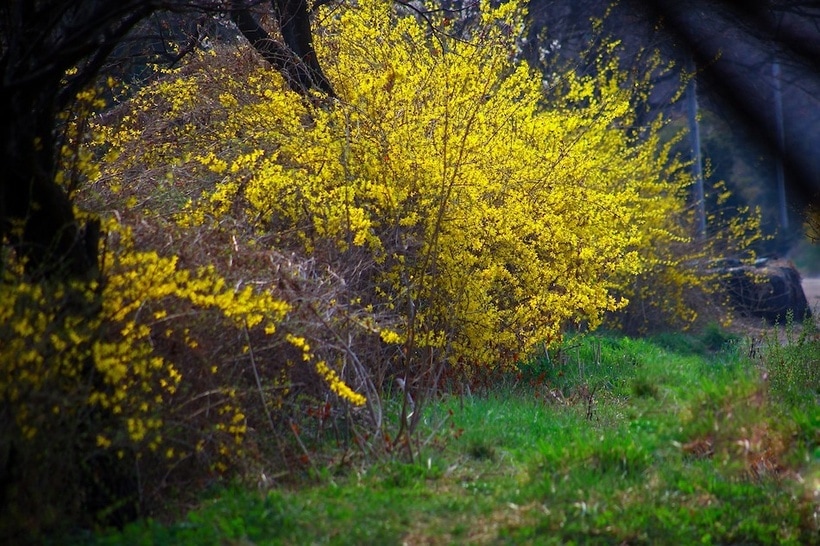
Here in the West, forsythia isn’t often thought of as an herb as it’s used more as a landscaping plant rather than a medicinal one, but it does have some great uses.
Forsythia is a shrub that can be left to grow wild or pruned and shaped into a neat hedge. It grows between 3’ to 8’ tall and up to 8’-10’ wide. It has a light brown bark covered in even lighter colored little bumps (lenticels). Twigs are hollow with a spongy white pith inside and form small, brown buds that eventually develop into 2-4 inch yellow, bell-shaped flowers in early spring. Flowers ultimately produce little bell-shaped green fruits about 1/3 of an inch long. Forsythia has 2-4 inch long coarsely serrated oval to oblong leaves that grow opposite one another. Leaves are darker on the top and lighter on the underside, and they turn to gold, purple, or orange after the first fall frost.
When it comes to wild foods, forsythia buds, young leaves, and flowers are all edible. Flowers are added sparingly to salads. Too many of them will make the salad too bitter. You can also eat the plant’s raw buds, but it is best to cook young (not mature) leaves before consuming them.
Where plant medicine is concerned, the fruit of the plant holds the key. As I mentioned earlier, here in the West, most forsythia shrubs you’ll see are an ornamental variety (Forsythia intermedia), and these do not produce fruit. If you want to use forsythia for medicinal purposes, you’ll want to use plants that do produce fruit, commonly the weeping forsythia (Forsythia suspensa).
Forsythia fruits or seeds can be harvested, dried, and used in a variety of herbal preparations. Forsythia is a cooling, drying plant, and it’s most well-known for its use as an anti-inflammatory, antimicrobial, and circulatory stimulant. Traditional uses include bronchitis, endometriosis, sluggish menses, parasitic infection, measles, tonsillitis, encephalitis, and meningitis. It is also said to help ease inflammation from seasonal allergies!
Nettle
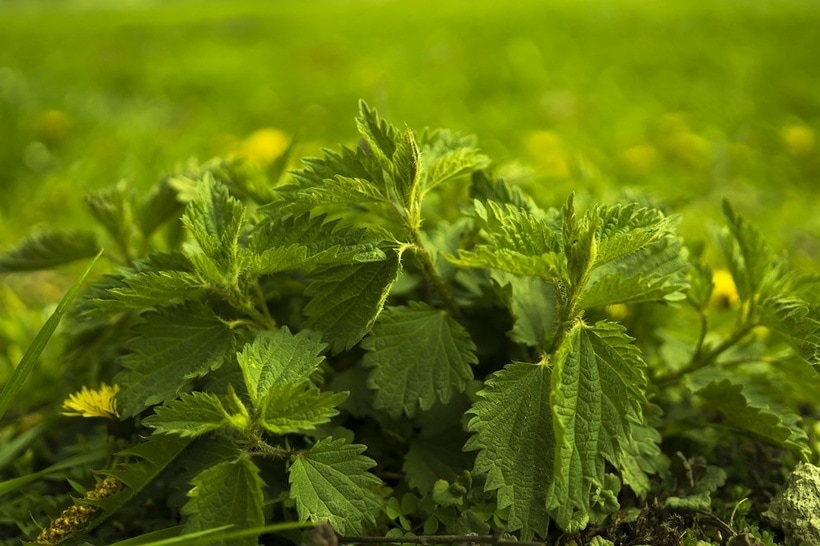
Nettle (Urtica dioica) is probably one of the most well-known spring herbs. Not only is it highly nutritious food, but it’s a useful spring tonic as well.
Nettle grows 2-4 feet tall. It has a robust square stem with sharply toothed, oval leaves that grow opposite one another up the stem, becoming smaller towards the plant’s top. Tiny hairs cover the stem and leaves, and these hairs sting the skin when touched. When harvesting fresh nettle, it’s a good idea to wear gloves! Nettle grows from a rhizome root system, so you will see it growing in clusters in moist, shady areas. Tiny green flowers eventually form at the axis of each leaf junction.
Like I mentioned earlier, nettle is a highly nutritious herb filled with vitamins, minerals, amino acid, chlorophyll, and formic acid — often labeled as a blood builder. It can be used fresh or dried in soups, pasta dishes, or vegetable sides. I like to add it to my morning smoothies!
It also has many other wellness benefits. Energetically, nettle is cooling, drying, and toning, so it may help conditions presenting with the opposite energetic qualities. It is an alterative herb and has an affinity for the kidneys and the lymphatic system. This action gives nettle its association as a blood purifier as it helps to move toxins out of the body. When stung with the hairs of nettle, it stimulates circulation to the sting site, flooding the area with fresh blood and lymph fluids, as well as immune cells that clean up waste. This increased circulation often provides relief to arthritic or swollen joints. Nettle can slow bleeding in various situations due to its vitamin K content. It also works exceptionally well to ease seasonal allergies due to nettle’s inflammation-easing histamine content.
Cleavers
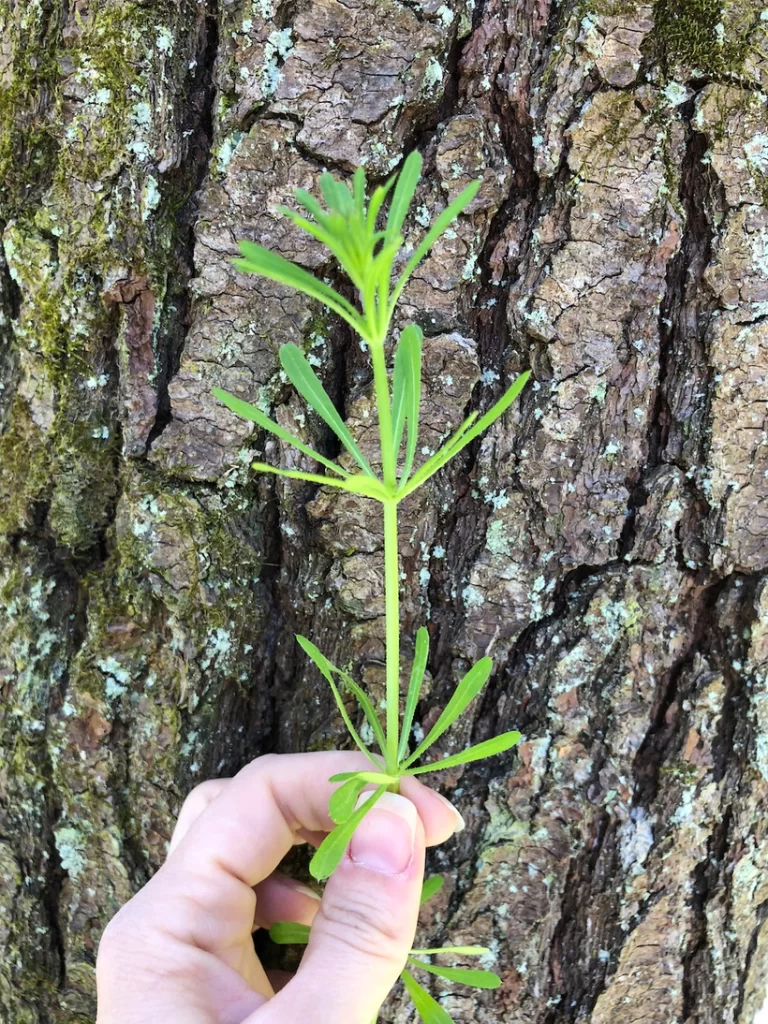
Cleavers (Galium aparine) is one of the first spring herbs to appear here in East Tennessee. It can be found in both sun and shade, although they seem to grow much better in the shade.
Cleavers is easy to identify because of its leaf pattern and because it will cleave or stick to you!
Cleavers has a square stem and can grow anywhere from 3 to 6 feet in length. It has green, narrow, lance-shaped leaves that grow in a whorl of 6-8 leaves up the stem’s entire length. Small, star-like, white flowers form that eventually produce a green to deep purple fruit. Tiny downward-facing hooked hairs cover the whole plant, and it’s these hairs that give cleavers its characteristic clinging ability.
Cleavers is a common edible for animals, but it isn’t so much for humans. While it is more edible when blanched first to remove the tiny hairs, it is typically found in the home apothecary rather than the kitchen.
When I think of cleavers, the first thing that comes to my mind is its use as an alterative or blood cleansing herb. It stimulates lymphatic flow, which helps to cleanse the body gently. This action gives cleavers various uses in the body, from tumors to calcification buildup to skin eruptions. Cleavers slows the bleeding of wounds or tighten and tone the skin after an injury, bite, or sting. Speaking of tightening tissues, cleavers is well-known for its action on the entire urinary tract due to its astringent and demulcent actions. Lastly, cleavers is often used as a nerve tonic to calm and soothe overly taxed or stimulated nerves.
Mullein
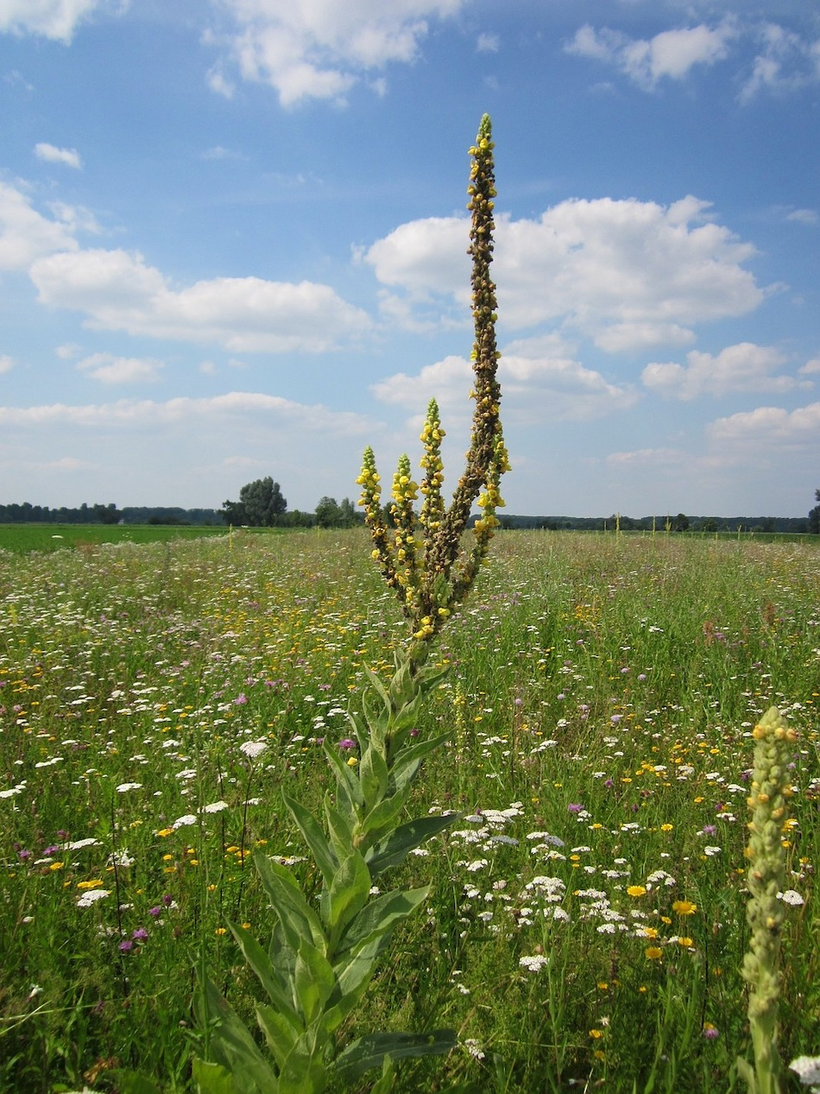
Mullein (Verbascum thapsus) is another common herb you’ll see growing in spring, and once you know how to recognize it, you’ll see it everywhere!
Mullein is a biennial plant which means it takes two years to move through its entire growth cycle! Year one starts at ground level with large hairy leaves that grow in a rosette pattern, and that’s it! In year two, a stalk emerges from the leaves’ center, growing 6-8 feet tall, and the leaves alternate up the length of the stalk. At the top of the stalk, yellow flowers with five petals grow that eventually form seeds. These seeds disperse at the end of the season, and new plants will grow, starting the cycle all over again.
Mullein has cooling, moistening energetics. It has an affinity for the respiratory, lymphatic, and joints of the musculoskeletal system. It has a pungent taste, which means it helps to get things moving in the body. It helps to soothe and ease inflammation and benefits coughs, tightness in the chest, earaches, achy joints, and more.
Lambsquarter

Lambsquarter (Chenopodium album) is another one of the nutritious spring edible herbs. The small, tender spring leaves are eaten raw, and the older, larger, more bitter-tasting leaves are typically cooked in soups or similarly to spinach to reduce. The seeds can even be dried and ground into flour.
Lambsquarter grows on a tall stem with lance-shaped leaves alternating up the stem. The leaves are smooth and delicate with a wavy, toothed edge. They are green on the top with a whitish appearance on the underside. Small, green flowers grow at the end of branches, eventually producing small, disk-shaped seeds.
Lambsquarter is a cooling, toning herb that has an affinity for the digestive tract and the skin. It brings cooling relief to fevers, bites, stings, and burns, and its astringent action is helpful for wounds, rashes, and diarrhea. It is also said to have antimicrobial properties, which makes it a particularly useful edible for the gastrointestinal tract and the skin.
Cattails
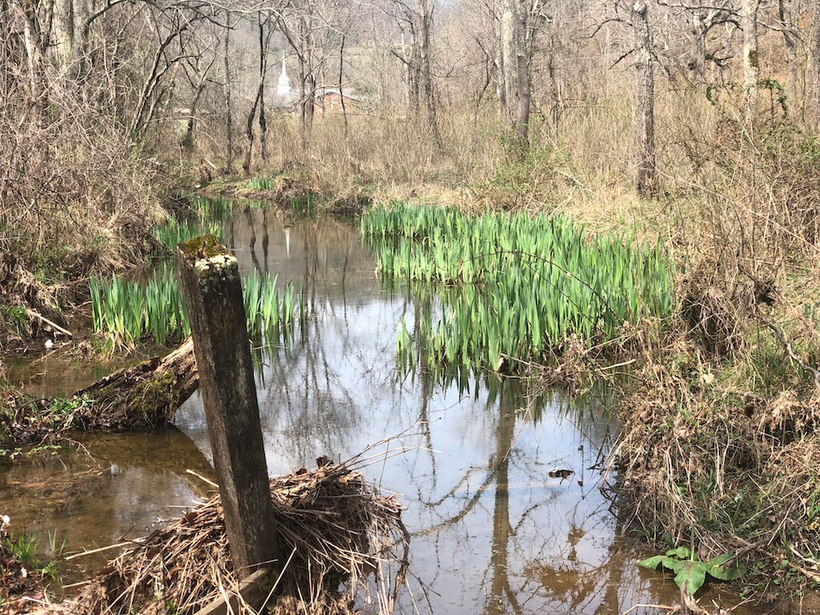
Cattail (Typha spp.) is a member of the grass family alongside rice, corn, wheat, oats, barley, and rye, and it is known as the “supermarket of the swamp.” Basically, it has a lot of uses for food and medicinal purposes.
Cattail grows between 4-7 feet tall and has a rhizome root structure that spreads, often becoming invasive in an area. Each plant has a few dozen flat, blade-like leaves that grow 1-3 inches wide. A 4-8 inch, greenish-yellow, cylindrical stalk shoots up in the plant’s center in mid-spring, where the characteristic brown seed head that has a firm yet fuzzy appearance eventually appears.
There are some poisonous Iris look-alikes, but none of these have the brown seed head when in full bloom. None-the-less, it’s important to positively identify any plant before harvesting and using it.
When it comes to the edible parts of a cattail, the entire plant is edible, from the young corms on the roots to the stems to the pollen that forms on the male seed heads to the young seed heads themselves.
Cattail is a moistening plant, which is quite fitting if you ask me, seeing how it grows in wet, swampy areas. It soothes burns, stings, and wounds. It’s also antiseptic, often using the leaves as spit politics or dripping the juice from the plant’s base directly on wounds and toothaches.
3 Safety Cautions to Know Before Harvesting or Using Herbs
First, before collecting and using any outdoor plant, it’s always a good idea to make sure you have correctly identified the plant in which you are interested. Many plants have look-alikes—some that are unsafe to use.
The easiest way to positively identify a plant is to have someone skilled in plant identification go on an herb walk with you. They can point out common herbs, explain what characteristics to look for, and tell you how to harvest them. Another option is to use plant identification guides to help you correctly identify a plant. I love Thomas Easley’s Botany in a Day and Peterson’s Field Guides. You can also take an online course in plant identification, such as the Botany & Wildcrafting Course from the Herbal Academy, or join a plant identification group on Facebook to get some identification help from the community there.
Next, before using any plant, it’s essential that you thoroughly research the plant to see what safety and dosage information you can find on it. Many herbal materia medica books will have this information as well as some online sources. Rosalee de la Forêt has a great list of herbal monographs on her website. I love Dr. Marisa Marciano’s blog, The Naturopathic Herbalist as well. The Herbal Academy’s membership site, The Herbarium, is also a valuable resource for herbal research.
If you have any chronic health conditions, are pregnant or nursing, or are taking any medications, use caution before incorporating certain herbs into your diet. It’s always a good idea to speak with your health care provider before taking any new supplements.
Lastly, make sure you’re practicing safe, ethical wildcrafting techniques. You can read more about how to wildcraft safely here.
In Closing
As you can see, there are a lot of herbs to learn about and identify in the spring season.
Let me encourage you to choose one of the above herbs and look for it around your home, in a local park, along the roadside, or as you walk through fields and meadows during the next few months.
Once you spot it, spend some time learning about it. Stock it in your home apothecary. Use it as much as possible and get some one-on-one experience with it.
You won’t regret it!!