





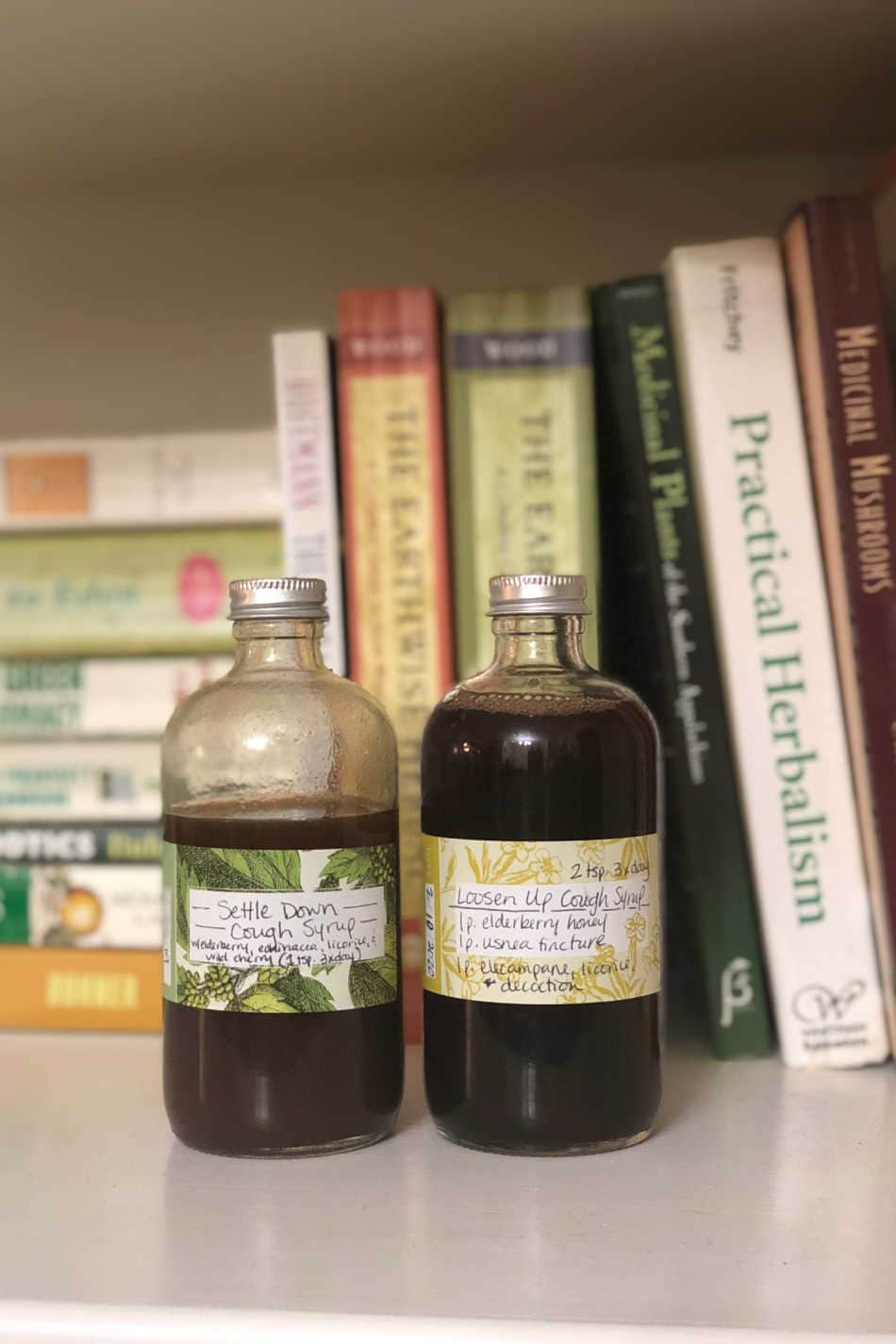
A few years ago, I shared a photo on Instagram talking about the only two cough syrups I keep stocked in my natural medicine cabinet — one for dry coughs and one for wet coughs. It was (and still is) one of my most popular posts, and I get asked all the time for the recipes.
Well, friends, the wait is over because today I’m sharing the recipes for both of these shelf-stable cough syrups as well as how I use them effectively.
Why Two Different Syrups
Now before I share the recipes with you, let me explain why I keep two different recipes on hand.
Basically, there are two different types of coughs — wet (productive) coughs and dry (unproductive) coughs.
Wet coughs are the kind where the tissues of the lungs secret a lot of mucous that either comes up when you cough (that’s the goal anyway) or stays stuck down in the airways, making your chest feel heavy like it’s hard to take a deep breath, and sometimes, you can even hear it rattling around in there.
Dry coughs are coughs where the tissues are so dry that you cough because there’s not enough mucous. This results in those constant, rib-cracking coughs that leave you with a sore throat, sore abdominal muscles, and headache because of all the coughing.
Both of these types of coughs can be supported with specific types of herbs, so if you’re going to have shelf-stable cough syrups on hand, you need to have two different versions, one for each type of cough.
Wet (productive) coughs benefit from herbs that are energetically warming and drying, and the primary herbal action you’ll be looking for here is stimulating expectorant herbs, such as thyme (Thymus vulgaris) leaf, elecampane (Inula helenium) root, and garlic (Allium sativa) bulb. These herbs help to loosen the excess mucous in the lungs and help it come up more easily during a cough, so it can be expelled from the body. Secondary herbal actions for a wet cough may also include immune-supportive and microbial-modulating herbs (aka, antibacterial herbs) that will help the immune system do its job and prevent a respiratory infection from setting in.
Dry (unproductive) coughs will benefit from herbs that are energetically cooling and moistening, and the primary herbal action you’ll be looking for here is relaxing expectorant herbs, which includes demulcent herbs, such as marshmallow (Althea officinalis) root, licorice (Glycyrrhiza glabra) root, mullein (Verbascum thapsus) leaf, and wild cherry (Prunus serotina) bark. These herbs help to moisten the tissues of the respiratory tract so they are less dry and irritated, and they also help by having a relaxing effect on the lungs. In addition to relaxing expectorants and demulcents, this relaxing effect can be through some secondary actions, such as relaxing nervines, sedatives, and antispasmodic herbs.
You can do a Google search to listen to these types of coughs if you’re curious to know what they sound like. In fact, I have a blog post all about deciphering coughs right here that has some links to cough sounds.
Once you figure out what type of cough you’re dealing with, you can then decide which type of cough syrup you would benefit from taking.
Let’s look at each below.
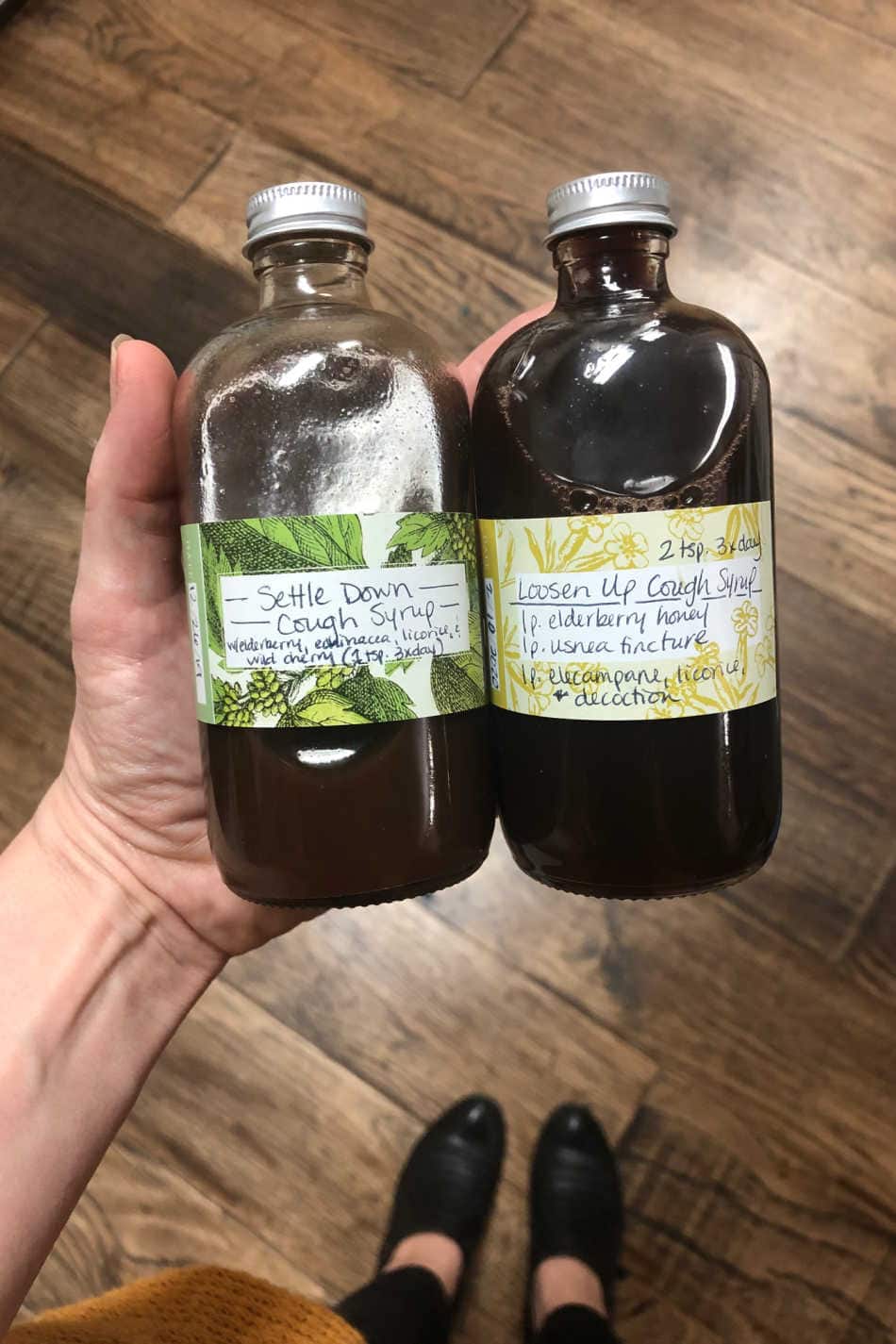
Productive (Wet) Cough Syrup Recipe
A productive cough syrup will be for productive wet coughs, and it will contain stimulating expectorant, immune-supportive, and antibacterial herbs that are warming and drying to counter the cool, damp environment of the lungs.
I’ve already shared how I like to make shelf-stable herbal syrups here on the blog, so please refer to that video when putting this syrup together. The following recipe will follow this method and contain 1 part herbal decoction, 1 part infused honey, and 1 part herbal tincture. Keep in mind that this is my base formula for a productive wet cough, but any of these herbs can be interchanged with others with similar actions. I dose this syrup at 2 teaspoons, 3 times a day for adults. You can find the appropriate dosage for a child here.
Producing (Wet) Cough Syrup Recipe
- 1 part elecampane and licorice root decoction (equal portions of herbs)
- 1 part elderberry honey
- 1 part usnea tincture
Unproductive (Dry) Cough Syrup Recipe
An unproductive cough syrup will be for unproductive dry coughs, and it will contain expectorant, demulcent, and nervine herbs, all of which have a relaxing effect and are cooling and moistening to counter the hot, dry environment of the lungs.
Again, I will follow the method for making a shelf-stable syrup, so my recipe will contain 1 part herbal decoction, 1 part infused honey, and 1 part herbal tincture. Like the productive cough syrup, this too is a base formula, and any of these herbs can be interchanged with others with similar actions. I dose this syrup at 1 teaspoon, 3 times a day for adults. You can find the appropriate dosage for a child here.
Unproductive (Dry) Cough Syrup Recipe
- 1 part echinacea and licorice root decoction (equal portions of herbs)
- 1 part elderberry honey
- 1 part wild cherry bark tincture
And there you have it – two well-formulated herbal cough syrups to keep on hand to address common coughs you may face any time of the year!
If you have any questions or comments, feel free to leave them in the comment section below!
Love and light,
Meagan