


Mullein.
There’s so much to say about this plant it’s hard to know where to begin. Not only does it grow all over the US and in many other parts of the world, but it’s one of the easier plants to identify and harvest. It has many valuable actions and can be used in a variety of ways and preparations. If I had to think of one word to describe mullein it would be “versatile”.
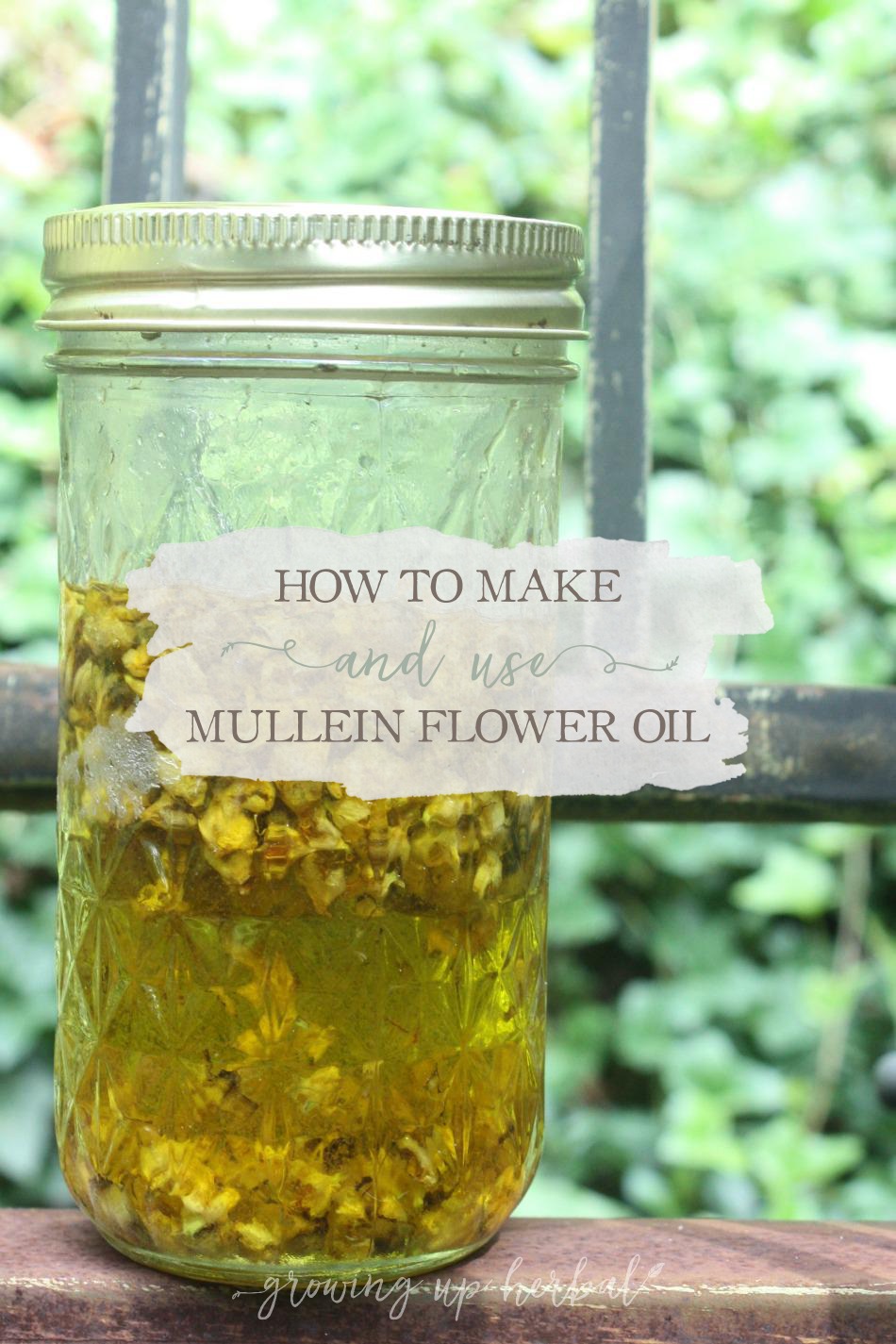
However, I’m not going to go into all the ways mullein can be used. You can look that information up for yourself. Instead, I’m going to simplify things and focus on using one part of mullein in one particular way. Today I’m going to teach you about using infused mullein flower oil. I’ll start by briefly discussing harvesting mullein flowers, prepping them for storage, infusing them in oil, and of course, some various ways you can then use that oil in your home.
Harvesting Mullein Flowers
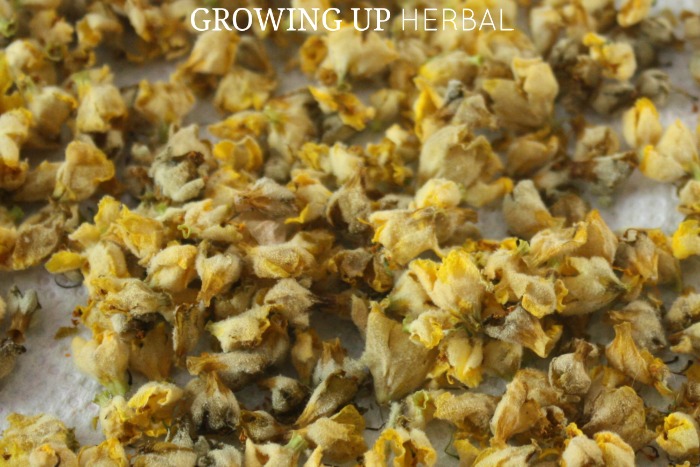
Mullein is one of the easiest herbs to identify for beginners. In fact, it was one of the first herbs I learned to spot in the wild. It grows everywhere and has a distinct look to it. It has large light green leaves with a white fuzz covering them and tall stalks growing out of each plant’s center. These stalks will be covered in bright yellow flowers in mid-to-late summer. Mullein prefers dry, rocky, poor-quality soils, and you’ll often find it growing alongside roads and up steep mountainsides.
If you’re interested in learning how to identify and forage plants, the Herbal Academy has a couple of wonderful courses designed to teach you all you need to know. Their Botany & Wildcrafting Course and Foraging Course are top-notch herbal courses and will teach you how to better identify and harvest plants in your area. The Herbarium is another wonderful resource that will help you learn about plants and their uses as well.
Mullein flowers are harvested from second-year plants (first-year plants do not produce stalks) usually in July, depending upon where you are located. Mullein flowers have a strange smell… not unpleasant, just different. Some people think it smells like vanilla, while others can’t quite put their finger on it!
It can be a chore to harvest mullein flowers, not because it’s difficult (you simply pick the flowers from the stalks) but because only a few flowers open on each plant daily. So unless you know of a place where lots of mullein grows and you can collect a bunch in one day, you’ll have to make several trips to collect enough flowers to use for the year. Herbalist Henriette Kress says that if you don’t have time to harvest the individual flowers, you can cut the entire mullein seed head off, chop it up, and use it in preparations as the oil found in the flowers is present in the entire seed head and works just as well as the flowers alone.
According to some herbalists, mullein flowers have the same actions as the rest of the plant, only to a stronger degree. I personally prefer to collect each of the different parts of the plant (flowers, leaves, and roots) and use them in different ways, but the more you use it, the more you’ll know which parts you like best and for what. My needs are limited because I mostly use herbs for my family (as I don’t work with clients right now).
What About Dried Mullein Flowers
Dried mullein flowers are fine to use in oil infusions as the resin and anti-inflammatory properties remain in the plant after it is dried.
Prepping Mullein Flowers For Use
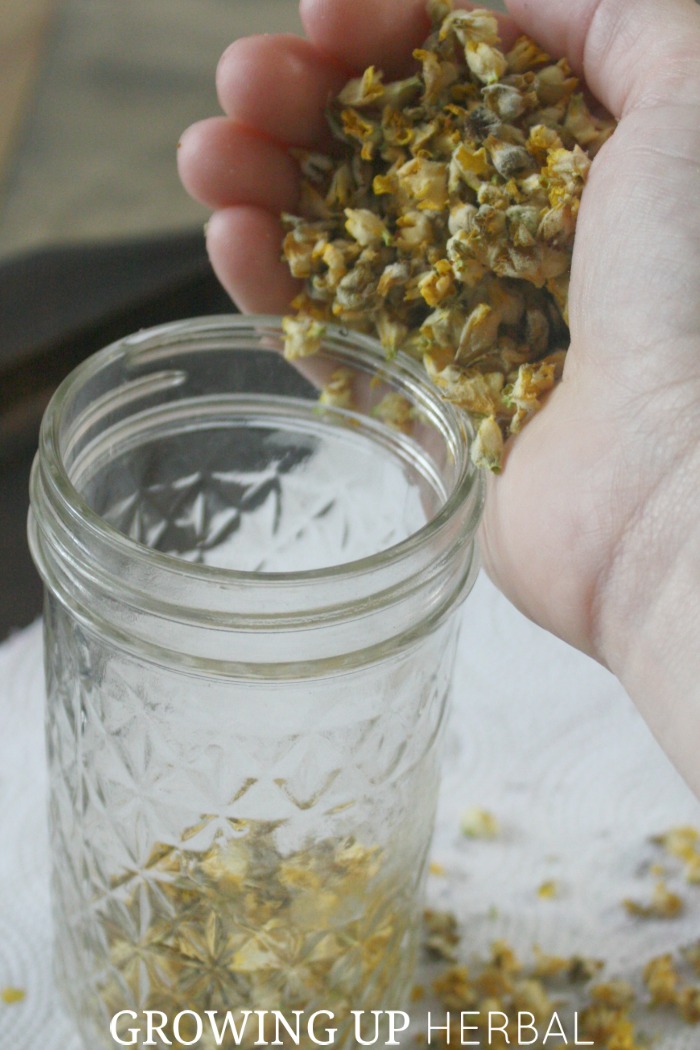
So after you’ve collected a good bit of mullein flowers, you’ll need to use either use them fresh immediately or dry them for storage.
You can use them fresh for tinctures, teas, and oils, and you can use them dry for all herbal preparations. I personally like to use fresh flowers in my tinctures, wilted flowers in my oils, and then dry the rest for storage in case I need them later.
Now, on to prepping the flowers for an oil infusion!
As soon as you get home from harvesting your mullein flowers, dump them out on a white sheet so the bugs will have a chance to crawl off. Don’t stress about getting every single bug off. You’re going to strain everything out of your preparations in the end anyway… bugs included. I also don’t wash my flowers; I like to leave them as is… pollen and all. Leave this to sit for an hour or so.
Next, gather your flowers and decide if you will use them fresh, wilted, or dried. I’ll go over the process for infusing both fresh and dried below. If you’re going to use them fresh, you don’t have anything left to do. If you’re going to use them wilted, simply leave them lying on your sheet for 2-3 hours to reduce their water content some more. If you’re going to dry them completely, you can sandwich them between two pieces of the screen (so they get good air circulation and don’t blow away), or you can dry them carefully in the oven.
If I’m in a hurry, I like to dry my flowers in the oven as it’s fairly quick. I take some parchment paper and cover a cookie sheet with it, put my flowers on top, and put another piece of parchment paper on top. Sandwiching the flowers between the two layers of parchment paper helps to keep the essential oils from evaporating out of the flowers and into your oven! I turn my oven on its lowest bake setting (170 degrees on my oven), and I use a wooden spoon to prop my door open so some heat can escape and my herbs can dry nice and gently without getting too hot. I check them ever so often, and as soon as they crunch like a cracker, I know they’re ready. Once they’re dried, store them in a clean glass jar in a cool, dark spot. Make sure you label them!!
Infusing Mullein Flowers In Oil
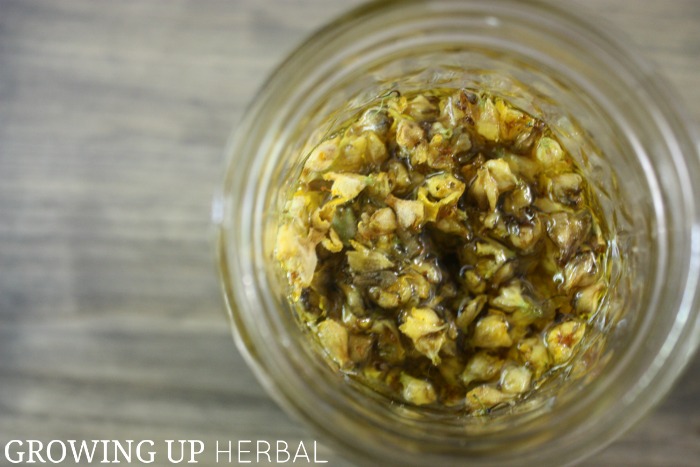
When I make mullein flower oil, I always use olive oil. Of course, you can use any kind of oil you prefer. I like to use olive oil because it’s easy to find, has great properties, isn’t as fragile and prone to rancidity as some other oils are, and is relatively cheap.
Mullein Flower Infusion using Fresh Flowers
When making a mullein flower infusion with fresh flowers, you’ll need to fill your jar with flowers, barely cover them in oil, and place the jar in a warm place over low heat. A crockpot or a saucepan on a low setting works great. You’ll leave the lid off so moisture from the flowers can escape and let it sit like this for 3 days. This is a great way to infuse herbs into oils if you’re in a hurry. The heat really helps to draw the properties out of the plant material and into the oil.
Mullein Flower Infusion using Dried Flowers
If you’re using wilted or dried mullein flowers in your oil, you’ll simply fill your jar with flowers, barely cover them in oil, and place them in a dark, cool cabinet for 4-6 weeks to sit. You can wrap your jar in a cloth and let it sit in a window seal as well as this will make a solar infusion.
One method is no better than the other, at least not that I can tell. It all depends on how quickly you need your oil and what you prefer. I try to stay prepared and give myself 6 weeks for all my macerations (oils and tinctures) as I just personally like to let things follow moon cycles. I have no evidence that it makes a better end product. That’s just what I feel is best personally. God gave us the moon, planets, and stars for signs and wonders, and I just enjoy using those things when I make herbal preparations. Plus, I love going about things nice and slowly. It makes me appreciate things more.
Once your oil has infused as long as you want it to, you must strain it well. I normally triple strain most of my oils just to be sure they’re free of all particles and herb matter. I start by warming the oil over low heat to help thin it. This helps it pass through filters better. First, pour your oil through a fine-mesh sieve. This should catch all the flowers and larger particles. Next, pour your warm oil through a clean piece of muslin cloth to catch finer particles, and lastly, you can pour it through a coffee filter to make sure your oil is extra clean.
5 Ways To Use Mullein Flower Oil
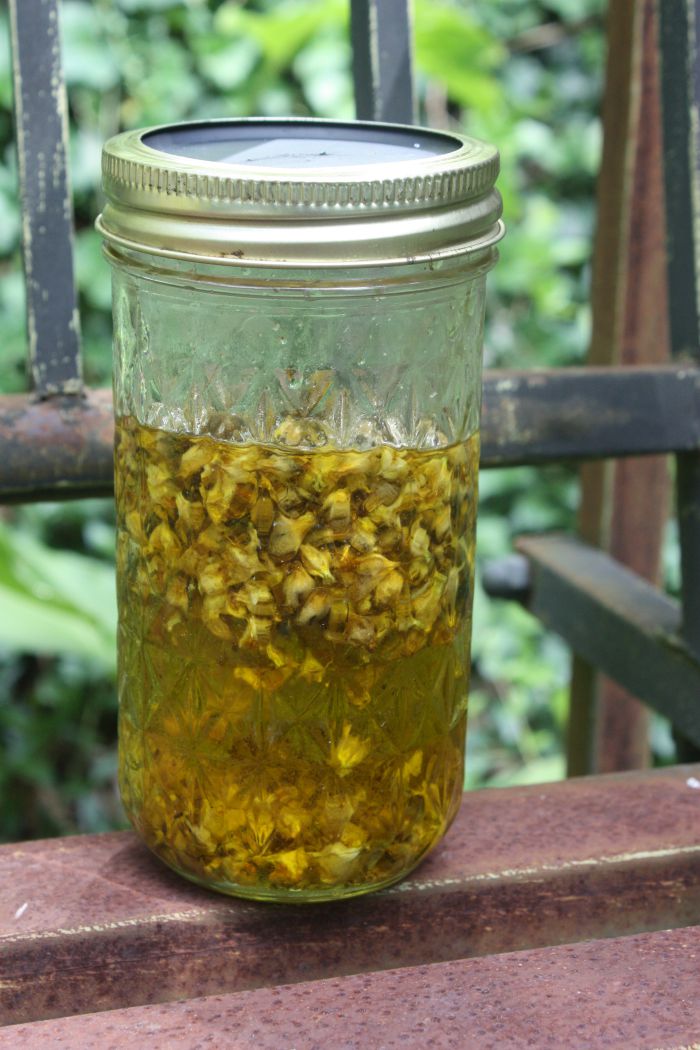
Mullein flower oil has many great herbal actions and uses, which we’ll look at below. Plus, it’s non-toxic and safe to use for all ages.
It has anti-inflammatory and anti-bacterial properties, making the oil great to have around for various uses.
1. Earaches
Using mullein flower oil for earaches is probably the most well-known use it has. In fact, it’s shown great results in several scientific studies. Thanks to its anti-inflammatory properties, it helps to reduce swelling and decrease pain in children with acute and chronic ear infections. It also has anti-bacterial properties, which makes it even more beneficial.
You can use mullein flower oil on its own or combine it with other herbs to create a powerhouse herbal earache formula. Only 2-3 drops in each ear are needed 3-4 times a day to bring relief.
2. Mouth Ulcers
Mullein flower oil can be used for all sorts of inflammations, including gum and mouth ulcers. It’s soothing and strongly antibacterial, which will help the body to heal itself in no time.
3. Skin Issues
Bug bites, sunburn, rashes, bruises, cuts & scrapes, wounds… mullein flower oil can be used for it all. Simply dip a cotton swab or cotton ball in it and gently apply it to the needed area several times a day to soothe inflammation and pain and to discourage infection from forming. You can also take this oil and make it into a salve if that’s more convenient.
Herbalist Kiva Rose Hardin says that mullein is an ancient wound herb that soothes inflammation and pain while preventing infection, reducing swelling, and aligning tissue for the best possible healing. It is specifically indicated where is a hard swelling of some kind and/or where there is a jagged wound unlikely to knit back together without significant scarring.
4. Massage Oil
Seeing as how mullein flower oil is well-known for its anti-inflammatory properties, it can be very beneficial for inflamed joints. You can apply the oil to the joint and gently massage it to stimulate blood flow, move lymph, warm the area, and promote absorption. Got a sprained ankle, a broken bone, arthritic hands, or swollen joint? You may find mullein flower oil to be of great help!
5. Postpartum
Mullein flower oil can decrease genital swelling and promote healing of lacerations after vaginal births, reduce pain and chance of infection after c-section deliveries, and help with hemorrhoids if those are postpartum issues. I think it would also be safe to say that mullein flower oil would also be great to use on varicosities.
So there you go, how to harvest mullein flowers, prep them for use, infuse them into oil, and 5 ways you can use them in your home. And if you can’t find fresh mullein in your area and would prefer to purchase dried flowers, Mountain Rose Herbs is my go-to source for all dried herbs.
So tell me, have you ever made your own mullein flower oil? If so, how do you use it? If you’ve never made it, tell me one way you would use it if you did make it.
REFERENCES:
-
Herb Mentor. (n.d.). Retrieved June 11, 2015, from http://herbmentor.com
-
The Herbarium at HANE. (n.d.). Retrieved June 11, 2015.
-
Sarrell, E., Mandelberg, A., & Cohen, E. (2001, July). Efficacy of naturopathic extracts in the management of ear pain associated with acute otitis media. Retrieved June 11, 2015, from http://www.ncbi.nlm.nih.gov/pubmed/11434846
-
Sarrell, E., Cohen, H., & Kahan, E. (2003, May). Naturopathic treatment for ear pain in children. Retrieved June 11, 2015, from http://www.ncbi.nlm.nih.gov/pubmed/12728112
I’ve really come to love mullein, too! I’ve really only used the leaves in our home, so experimenting with the flowers is definitely on my list. I like that you don’t have to worry about all the tiny hairs like you do with the leaves. I also get excited when I see it along roadways. 🙂 Such a fun, useful plant!
I know! I’ve only used the leaves up until now as well. I also read wonderful things about mullein root tinctures from first year plants (the ones with no stalks or flowers… just leaves) so I’m gonna have to find one and tincture the root to see what I think about it. I love experimenting with herbs!
The root of mullen really help back pain as a tonic or ticture
Yes! Herbalist jim mcdonald has a great article on his website, HerbCraft.org, about mullein root and back pain!
I’m a mama 64 yrs young….Yearly I get bronchitis or neumonia. This year I can’t take Antibiotics as I suffer from CANDIDA!!
It always starts with a sever Tickle that won’t go away then drainage at back of throat…I’ve tried honey ..onion and jelly syrup & other things. If you know of something I can try plz let me know!!
I’m not getting flue shot!!!
Most Sincerely
Darcy Canas
I’m sorry for your trouble Darcy. Do you have my Herbal Remedy Recipes ebook yet? It’s free and it has a throat spray in it that is amazing for colds and infections that start in the throat. You’d want to use it ASAP when you feel that tickle and it wouldn’t hurt to take a few larger doses of echinacea root tincture too to stimulate your immune system a bit. You can also try diffusing antimicrobial essential oils to help keep combat bacteria and viruses in the air. I have some suggestions for using them in this post here. Hope this helps!
Have you tried chaga tea or even better try Double extract chaga
There are many natural things out there that will help with candida.
I harvested mullein the first time this year–only the leaves as the flowers had already faded 🙁
I dried them, crushed them and made mullein leaf oil–I use it in my diffuser with lavender, eucalyptus, lemongrass etc. when we all have colds. We have also lit some of the dried leaves and inhaled the smoke-it seems to clean out the lungs pretty well!
Next year, hopefully I can forage some flowers as well!
Thanks for sharing Staci. I’ve never burned the leaves, but I know that used to be a go-to remedy for lung ailments with many Native American tribes.
Staci, please don’t use any type of carrier oil in your diffuser, it can ruin it. The infused mullein leaf is in an oil like olive, unrefined coconut or something similar. Ultrasonic diffusers are meant for essential oils only. I know that you did this earlier this year so this is for future reference.
I have smoked the flowers to open up my bronchial tubes. It really helps. 30 years ago, when raising my children, if one of them had a respiratory problem, we picked mullein leaves and made a steam for them. That worked too!!!
Thanks for sharing, Ronita! I love hearing how others use herbs and how it has worked for them!
Can you plz share how to do that? Make it to use? Ty plz explain how it was used for pain? Ty
I was told that the seeds are toxic. If I use the whole head of the Mullein and it has partially gone to seed, will the oil be toxic?
From what I know of mullein, the seeds aren’t used at all… except to grow more mullein plants. 🙂 Most herbalists use the flowers, leaves, and root for various purposes. The flowers are always picked or stripped from the seed head, but the seeds are sifted out and the flowers only are used. I’ve never read anywhere about mullein seeds being toxic so I’m not sure in what way they’re toxic. All I know is that they’re aren’t used in modern herbal medicine. If you have info on why and how they’re toxic, I’d love to know about it. Thanks for your comment, Kelly!
5
4
0.5
If you harvest the whole flower stalk you will no doubt get some seeds too, so it’s important to know if the seeds are toxic. You had stated in this article, “Herbalist Henriette Kress says that if you don’t have time to harvest the individual flowers you can cut the entire mullein seed head off, chop it up, and use it in preparations as the oil found in the flowers is present in the entire seed head and works just as well as the flowers alone.”
The only thing I’ve ever found about the seeds being toxic was from A Modern Herbal which said they were used as a fish poison in the early 20th century (having a narcotic effect), but it also said that some mullein species seeds were used to expell tapeworms as well. Most herbal recipes that call for mullein leaf, flowers, and root, not the seeds, so it’s rare that anyone would use them. With that said, Henriette is a well-known, experienced herbalist, and I respect her opinion. From the source mentioned earlier, it seems that any toxic effect from the seeds is only associated with internal use, not external use, and therefore, using the whole mullein seed head in an infused oil would be just fine.
Can you diffuse Mullein leaf essential oil?
I’ve never heard of mullein leaf essential oil. However, if they make it, and it’s a fit for you and your needs, I’m sure it can be diffused.
For the olive oil- if you leave it in a jar for 4-5 weeks or an entire moon cycle, will it get moldy? My plan is to do this but just wanted to check here first. Then I will make salves with the oil. Thank you for any advice!
When infusing fresh herbs into oil, it can be done, but sometimes it’s tricky. It really depends on the herb you are infusing and how much water is in the plant material. Mullein flowers have a high resin content so they do well with fresh oil infusions, but that doesn’t mean they won’t mold. There are some things you can do to decrease your chances of it molding such as infusion over heat and letting the flowers wilt a bit first. I have another post about fresh oil infusions over on the Herbal Academy blog. You can find that post here. Perhaps something there will be helpful as well! Good luck!
I’m thinking about mullein oil for my cats ears. They seem to be chronically in need of medicine for brown and grayish yuck. The vet set me up with antibiotic Salve, but maybe the mullein oil would be useful. It’s too late this season for flowers, but I do know a place where one could pick enough mullein flowers at one time to use for a batch of oil. Next summer will have to make some and see if it can stand in for the medicine.
Yes! Animals can definitely benefit from herbs just as we can. Best of luck, and I’d love to know if you have success with your cat!
I read that you should not pick the flowers in the evening because by that time they contain Glycosides.
Why would glycosides be bad and what happens if you don’t pick the flower till the next morning does it still contain glycosides? I do know not to put too much stevia in your tea it will get overly sweet a bit of caution there.
I have never heard this about glycosides and mullein. I’ve also not heard that glycoside levels change in plants throughout the day. Throughout the growing season, sure… that makes sense as some phytochemicals change as the plant matures or ages. Most flowers are harvested mid-morning when the dew has evaporated but it’s not too hot for the flowers to lose their volatile oils. I’d recommend that when harvesting mullein flowers. Hope that’s helpful.
I have Mullein growing every where on our property and always wanted to know it’s uses. Thank you so much for posting this.
My husband has varicose veins and open sores that wont heal because of the inflammation. Doctors can never seam to get the right ointment to help. I know the healing power of this plant but did not know how to process it. we will experiment on a tiny area with oil and go from there.
I’m so glad you found this article helpful, Jenni. I hope it helps your husband, but you may want to go even deeper than surface-level treatments and work on approaching the root cause of his issues where possible. You’ll get much better results that way.